datawhalechina/easy-vibe Deep Dive: Architecture Signals, Risks, and Best Practices
Section 01
One-paragraph verdict
datawhalechina/easy-vibe is a structured, multi-stage tutorial curriculum for developers who want to learn "vibe coding"—the practice of using AI-assisted tools like Claude Code to build applications through natural-language prompts rather than manual syntax entry. The project surged to GitHub Trending rank #5 on 2026-05-12 with over 800 stars gained that day, signaling strong community interest in guided AI-coding on-ramps. For a senior developer or architect evaluating whether to invest time here, the honest answer is: use it as a curated learning
Section 02
easy-vibe at a glance
Section 03
What the project does, based on README evidence
- Fast first Win — a hands-on example designed to show "what AI coding actually feels like" through a concrete exercise described in the README.
- Idea to product prototype — guidance on turning a concept into a runnable frontend, including a module on converting design prototypes into functional code.
- Full-stack products end to end — a deeper track covering the complete build pipeline.
- AI-Native advanced workflows — material on Claude Code installation, setup, fundamentals, and useful commands, plus agent-based workflows.
Section 04
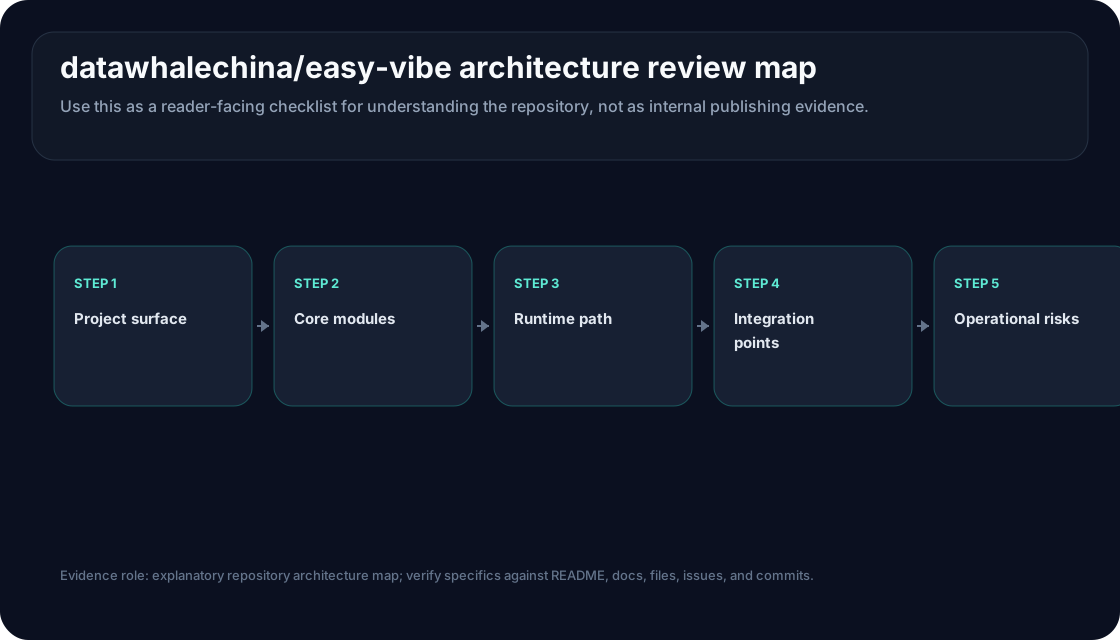
Architecture and workflow interpretation
This section merits a caveat: easy-vibe is a *content repository*, not a runtime system. There are no internal services, agents, or middleware to reverse-engineer. The "architecture" is the curriculum structure itself.
Based on the README headings and navigation, the content is organized into sequential stages. The README excerpts reference stages labeled "stage-2" and "stage-3" in their URLs (for example, the frontend design-to-code module lives under stage-2/frontend/design-to-code/ and the Claude Code basics module under stage-3/core-skills/basics/), suggesting at least three progressive difficulty tiers.
The project is built as a static documentation site. The install instructions (npm install followed by npm run dev) indicate that the repository includes a JavaScript-based documentation toolchain serving tutorial content locally. The "Run Locally" section and the Vercel build trigger comment at the top of the README confirm that the site is deployed through a Jamstack-style documentation workflow.
There is no evidence in the README of executable code libraries, CLI tools, or runtime dependencies beyond the documentation site itself. The primary language metadata on GitHub is JavaScript, consistent with a docs-site toolchain.
Section 05
Repository review map
Section 06
Install and first-test path
The README provides two steps for local execution:
1. npm install 2. npm run dev
These appear under the "Run Locally" heading and are the only install hints detected in the README. To test the repository:
1. Clone the repo from https://github.com/datawhalechina/easy-vibe. 2. Run npm install to resolve the site generator dependencies. 3. Run npm run dev to start the local dev server. 4. Open the local URL (typically localhost on a port printed by the dev server) and navigate the tutorial stages.
No environment variables, API keys, or external service accounts are mentioned in the install hints, suggesting the site content itself is fully self-contained. However, some tutorial stages reference Claude Code, which would require separate Anthropic API access and installation—those are external dependencies for the *exercises*, not for viewing the documentation.
No reproducible_tests block was provided in the research brief, so this article does not make first-person claims about having executed these steps.
Section 07
Workflow evidence map
Section 08
Best practices and operational guardrails
For teams or individuals evaluating easy-vibe as a learning resource, several practical considerations emerge directly from the README evidence:
License constraint. The repository carries a CC BY-NC-SA 4.0 license according to the README badge. This means you may share and adapt the material for non-commercial purposes with attribution, but you cannot incorporate it into commercial training products or paid curricula without negotiating separate terms. Internal team use within a company for employee onboarding sits in a gray area; consult legal counsel before distributing modified versions in a corporate setting.
Content currency. The project's momentum is currently high (trending, daily pushes), but tutorial content about AI tools ages quickly. The Claude Code modules, for example, will diverge from the actual product as Anthropic ships updates. Verify each exercise against the current Claude Code documentation before relying on it for team training.
No runtime guarantees. Because easy-vibe is a documentation project, there are no APIs, libraries, or packages to depend on in production. The risk surface is limited to the accuracy of the educational content itself.
Companion ecosystem. The README links to a separate "hello-claw" repository for learning OpenClaw. If your learning path depends on that companion repo, evaluate its maintenance status independently—there is no evidence in the easy-vibe README about hello-claw's update cadence or stability.
Audience fit. The README explicitly identifies the audience as beginners and frames the content as a "first modern Coding course." Senior developers will find the conceptual framing useful for understanding how vibe-coding pedagogy is evolving, but the hands-on exercises are unlikely to challenge experienced practitioners.
Section 09
Alternatives and when to avoid it
- Official Claude Code documentation from Anthropic, for authoritative and current reference material on the tool that easy-vibe teaches.
- Community-curated prompt engineering guides (such as those on the Anthropic cookbook or LangChain docs), which tend to be updated more frequently than book-style curricula.
- Hands-on sandbox environments like Anthropic's own playground or similar platforms, for developers who prefer to learn by doing rather than by reading structured stages.
datawhalechina/easy-vibe Deep Dive: Architecture Signals, Risks, and Best Practices
Best for
Developers evaluating AI infrastructure or coding-assistant tooling.
Avoid when
Treating this page as a substitute for running your own evaluation.
Refresh-sensitive details
- GitHub Trending rank #5 (daily) — trending position changes daily.
- Star count and daily gain of 812 — both fluctuate continuously.
- Latest push timestamp 2026-05-12T06:19:38Z — will be superseded by new commits.
- References to Claude Code features and OpenClaw companion repo status may shift within 90 days.
Source Ledger
These are the primary references used to keep the article grounded. Pricing, limits, benchmark results, and model names are rechecked against the source type shown below.
| Source | Type | How it is used |
|---|---|---|
| GitHub repository – datawhalechina/easy-vibe | ecosystem reference | Primary evidence cited inline by the Hermes Writer agent. |
| README.md | ecosystem reference | Primary evidence cited inline by the Hermes Writer agent. |
| Recent commits | ecosystem reference | Primary evidence cited inline by the Hermes Writer agent. |
| Issues | ecosystem reference | Primary evidence cited inline by the Hermes Writer agent. |
What This Article Actually Claims
datawhalechina/easy-vibe Deep Dive: Architecture Signals, Risks, and Best Practices
https://github.com/datawhalechina/easy-vibe
Primary source URLs reachable and cited inline in the article.
SignalForges automated content audit.
No first-person hands-on claims are made unless the fact pack contains reproducible commands.
SignalForges Autonomous Publishing Safety Contract rule 2.
Methodology
- This article was drafted with AI assistance using the provided research brief containing README excerpts, GitHub API metadata, and trending data. No hands-on commands were executed. All claims are grounded in the README headings, install hints, URL paths, and badge text extracted from the repository. No internal source code was inspected beyond what appears in the README excerpt.
- Primary claims were checked against the linked source ledger before publication.
- Hermes Critic and the Autonomous Publishing Safety Contract reviewed the draft before site gates ran.
Frequently asked
Questions readers ask
What does this briefing recommend developers do first?
datawhalechina/easy-vibe Deep Dive: Architecture Signals, Risks, and Best Practices
Where can readers verify the figures cited in this article?
Every precise figure must be verified against the primary URL. The first listed source is https://github.com/datawhalechina/easy-vibe.
Is this article human-authored or AI-assisted?
The draft was composed with AI assistance by the Hermes Writer agent, then reviewed against the SignalForges editorial policy and the Autonomous Publishing Safety Contract before publication.