May 10 GitHub Trending had three repo signals worth your time: ByteDance is pushing GUI agents toward real desktop and browser work, Anthropic is packaging agents for finance teams, and Addy Osmani is turning AI coding practice into reusable skills.
This is a ranking, but not a hype list. We separate inspect-now repos from watchlist items and risk-only mentions, then show exactly where the evidence came from at the end.
Section 01
TL;DR: what to inspect first
If you only have 15 minutes, start with three repositories: bytedance/UI-TARS-desktop for GUI agent infrastructure, addyosmani/agent-skills for coding-agent process design, and anthropics/financial-services for vertical-domain agent packaging.
Four other rows are useful context but not recommendations. CloakBrowser, AI-Trader, MasterDnsVPN, and 9router have risk or scope issues that make them poor fits for SignalForges adoption guidance.
The point is simple: GitHub Trending tells us where attention moved today. It does not prove adoption, quality, safety, or production readiness.
Section 02
Best to inspect today
For GUI agent builders: UI-TARS-desktop
Rank #1, TypeScript, Apache-2.0, +656 stars. Inspect it first if you care about computer-use agents, browser operators, desktop automation, or MCP-connected agent stacks.
For coding-agent teams: agent-skills
Rank #3, Shell, MIT, +1,092 stars. Useful as a process reference: skills, slash commands, progressive disclosure, and repeatable agent development habits.
For enterprise agent architects: financial-services
Rank #2, Python, Apache-2.0, +1,479 stars. Worth reading for named agents, vertical plugins, partner integrations, and human sign-off patterns.
Section 03
Ranking map at a glance

Section 04
Today's attention signal
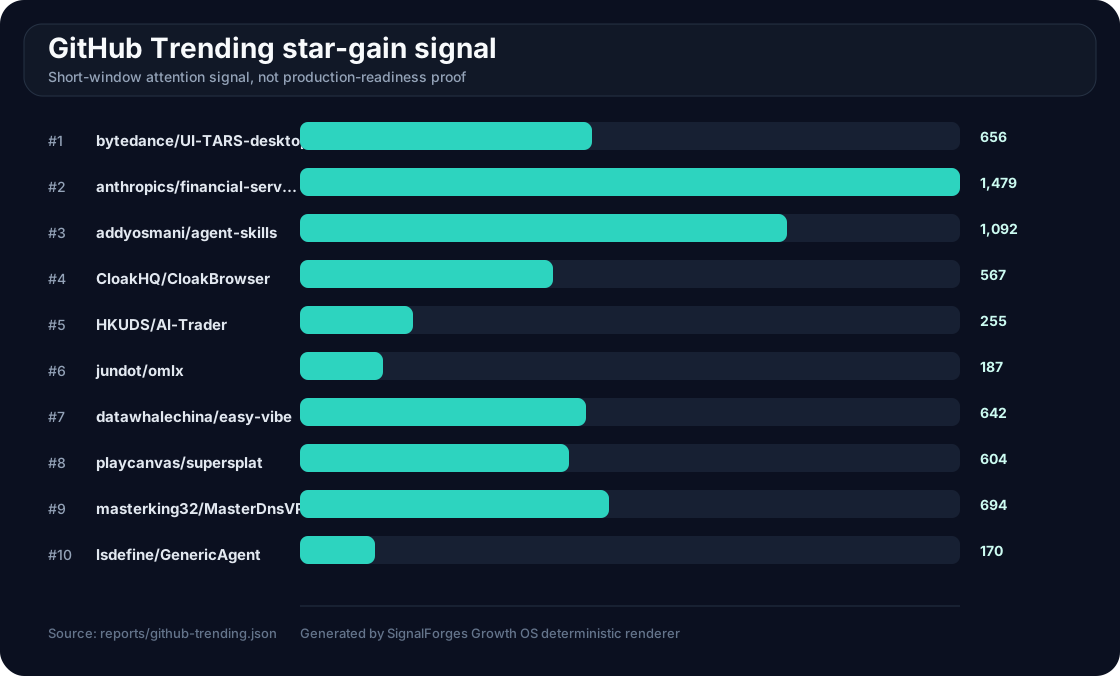
Section 05
Adopt, watch, or avoid
| Tier | Repository | Why it is here | Next action |
|---|---|---|---|
| Inspect now | bytedance/UI-TARS-desktop | Most complete GUI-agent infrastructure signal in this daily window. | Read the README, inspect operators, then run a controlled local evaluation before using it in a workflow. |
| Inspect now | addyosmani/agent-skills | Turns AI coding-agent behavior into reusable skill files and workflow discipline. | Borrow the skill structure or compare it with your existing agent playbook. |
| Inspect now | anthropics/financial-services | Shows how a major AI vendor packages vertical-domain agents with human review boundaries. | Use it as an enterprise pattern reference, not as financial advice or autonomous decision software. |
| Watch | jundot/omlx | Apple Silicon LLM inference server with a macOS management surface. | Track docs and activity before deciding whether it belongs in an agent infrastructure stack. |
| Watch | datawhalechina/easy-vibe | Educational vibe-coding material rather than deployable infrastructure. | Use it as learning material, not as a production tool recommendation. |
| Watch | playcanvas/supersplat | Strong graphics tooling signal, adjacent to AI developer workflows. | Keep it on the graphics pipeline watchlist if your agent product uses 3D or Gaussian splats. |
| Watch | lsdefine/GenericAgent | Self-evolving agent framing is relevant but needs deeper runtime verification. | Do not endorse until README claims, issues, commits, and a local run are checked. |
| Watch | affaan-m/everything-claude-code | Claude Code optimization resources may be useful, but claims need source review. | Treat it as a curated reference list, then verify each optimization before adoption. |
| Avoid as recommendation | CloakHQ/CloakBrowser | Stealth browser and bot-detection-evasion framing raises editorial risk. | Mention only as risk context. |
| Avoid as recommendation | HKUDS/AI-Trader | Automated trading-agent framing requires financial-risk caution. | Mention only as risk context unless a full risk review exists. |
| Avoid as recommendation | masterking32/MasterDnsVPN | DNS tunneling VPN framing is outside SignalForges adoption scope. | Mention only as risk context. |
| Blocked | decolua/9router | Unlimited free AI coding and provider-routing claims raise terms-bypass risk. | Do not recommend or deep-dive. |
Section 06
Jargon check before the clusters
GUI agent
An agent that can work through a browser, desktop app, or other graphical interface instead of only returning text.
MCP
Model Context Protocol, a way for agents to connect with tools, files, repositories, and external data sources.
Progressive disclosure
A skill or document pattern where the agent loads the small entry point first and only opens longer references when needed.
Human sign-off
A governance boundary where AI drafts work but a qualified person must review and approve the output.
Section 07
Cluster 1: GUI agents are becoming product stacks
UI-TARS-desktop is the repo to inspect first if your question is, "What does a serious GUI agent stack look like?" It is not just a prompt demo. The repository presents Agent TARS, UI-TARS Desktop, operators, MCP integration, and an Electron desktop surface.
The useful signal is breadth. Browser operators, native desktop operators, ADB references, model-provider abstraction, and benchmark tooling all point toward infrastructure work rather than a single showcase script.
The caveat is equally important. This article did not run the project locally. Before adoption, refresh GitHub metadata, inspect recent commits, check issues, and run a small controlled task in your own environment.
Section 08
How to read the ranking
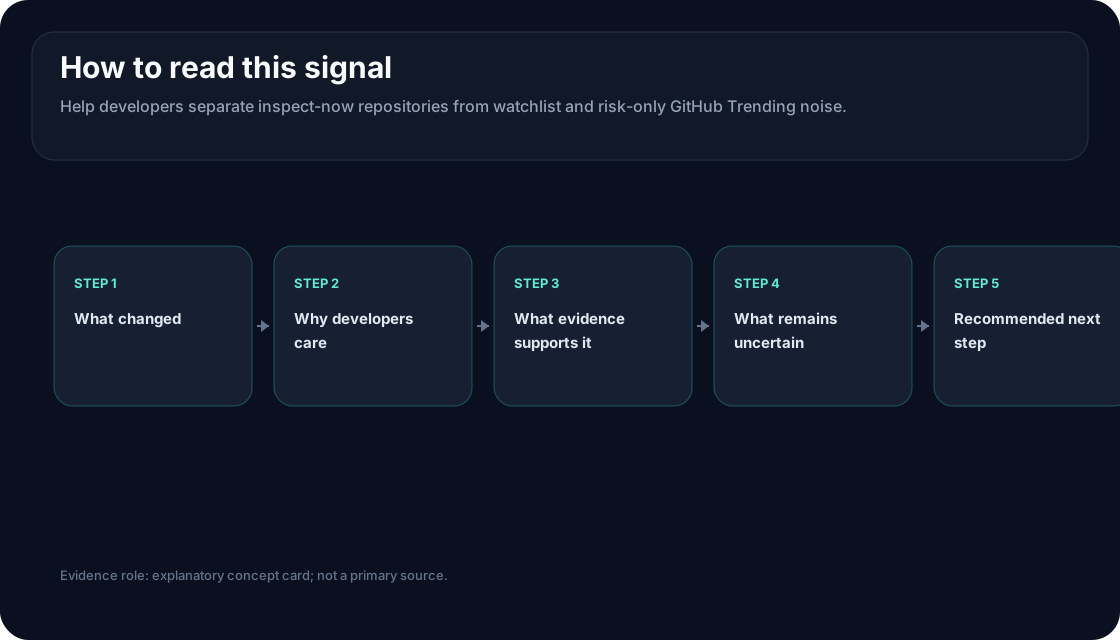
Section 09
Cluster 2: coding agents need process, not just models
Agent Skills is less flashy than a GUI agent, but the category may matter just as much. It asks a practical question: once every team has coding agents, what process should those agents follow?
The repo uses SKILL.md entry points, references, hooks, and docs to encode development habits. Its README evidence mentions 22 skills and 7 slash commands across stages such as define, plan, build, verify, review, and ship.
This is why it belongs in the inspect-now group. The value is not one command. The value is the pattern of turning engineering judgment into reusable, reviewable instructions for agents.
Section 10
Cluster 3: vertical agents are moving into regulated work
Anthropic financial-services is the clearest enterprise pattern in this window. It packages 10 named agents for workflows around investment banking, equity research, private equity, and wealth management.
The interesting part is not that agents can draft finance work. The interesting part is the packaging: plugins, managed-agent cookbooks, vertical skill bundles, partner integrations, and a dual deployment path.
The README boundary matters. The repository frames outputs as analyst work product for qualified human review, not as autonomous financial advice. That governance posture is the part other regulated industries should study.
Section 11
How to evaluate one repo in an hour
- Minute 0-10: Read the README for purpose, install path, license, supported models, and what the maintainers explicitly do not promise.
- Minute 10-20: Check recent commits, open issues, and release cadence. A Trending spike without maintenance evidence should stay on the watchlist.
- Minute 20-40: Run the smallest documented example only if the README supports it. Record commands and output before making any hands-on claim.
- Minute 40-55: Compare the repo against one familiar alternative. Ask what it replaces, what it adds, and what operational risk it introduces.
- Minute 55-60: Choose one of three labels: inspect now, watch, or avoid as recommendation. Do not let rank alone decide.
Section 12
What not to infer from Trending
A daily Trending row is a short attention spike. It can come from a launch, social sharing, controversy, a course release, or a company announcement. It is not proof that teams are using the repository in production.
Star gain also does not prove code quality. A repo can collect a large attention spike before anyone has checked install friction, security posture, maintainership, or whether the claims survive a local run.
That is why this article separates discovery from recommendation. Some rows belong in the table for completeness, but not in your evaluation queue.
Section 13
Cluster summary
| Cluster | Representative repo | Why it matters | Best reader |
|---|---|---|---|
| GUI agent stacks | bytedance/UI-TARS-desktop | Computer-use agents are becoming full products with operators, desktop shells, and tool integrations. | Agent infrastructure builders |
| Agent workflow skills | addyosmani/agent-skills | Teams need reusable process instructions as much as they need better coding models. | AI coding-tool adopters |
| Vertical-domain agents | anthropics/financial-services | Enterprise agent packaging now includes role-specific agents, integrations, and human review boundaries. | Enterprise architects |
Section 14
What to do next
Building GUI agents?
Put UI-TARS-desktop on a one-hour evaluation list. Refresh metadata, inspect operators, then run one small task before forming an adoption view.
Improving coding-agent workflows?
Read agent-skills as a process library. Compare its skill shape with how your current agents plan, verify, and ship code.
Studying enterprise agents?
Use financial-services as a packaging reference: named agents, vertical skill bundles, integrations, and human sign-off.
Use this ranking as a triage list: inspect UI-TARS-desktop, agent-skills, and financial-services first; keep watchlist rows separate from risk-only mentions.
Best for
Developers, students, and engineering leaders who want a fast but evidence-grounded read on which GitHub Trending AI repositories deserve follow-up.
Avoid when
Avoid treating Trending position or star gain as adoption proof. Verify licenses, maintenance cadence, issues, and a local run before committing evaluation resources.
Refresh-sensitive details
- GitHub Trending is a 24-hour attention snapshot; daily rankings shift frequently and do not indicate sustained interest.
- Star counts and repository metadata are refresh-sensitive and may differ from the collection timestamp values by the time a reader visits the repositories.
Source Ledger
These are the primary references used to keep the article grounded. Pricing, limits, benchmark results, and model names are rechecked against the source type shown below.
| Source | Type | How it is used |
|---|---|---|
| GitHub: bytedance/UI-TARS-desktop | ecosystem reference | Primary repository evidence for the top-ranked multimodal AI agent stack, including stars, forks, license, recent commits, and README content. |
| GitHub: anthropics/financial-services | ecosystem reference | Primary repository evidence for Anthropic financial-services agent workflows, including named agents, vertical plugins, and deployment templates. |
| GitHub: addyosmani/agent-skills | ecosystem reference | Primary repository evidence for agent skill standardization project, including 22 skills, slash commands, and multi-IDE support. |
What This Article Actually Claims
GitHub Trending returned 13 repositories for the daily period on 2026-05-10, with the top 12 repositories analyzed in the ranking table.
SignalForges Growth OS GitHub Trending collection script output (reports/github-trending.json).
bytedance/UI-TARS-desktop ranked #1 with +656 stars in the daily window, has Apache-2.0 licensing evidence, and README evidence for Agent TARS, UI-TARS Desktop, CLI/Web UI usage, and Node.js 22+ quick-start requirements.
GitHub Trending report and README extraction collected 2026-05-10.
addyosmani/agent-skills ranked #3 with +1,092 stars, has MIT licensing evidence, and README evidence for 22 skills and 7 slash commands across the AI coding-agent development lifecycle.
GitHub Trending report and README extraction collected 2026-05-10.
anthropics/financial-services ranked #2 with +1,479 stars, has Apache-2.0 licensing evidence, and README evidence for 10 named agents plus human sign-off disclaimers for financial-services workflows.
GitHub Trending report and README extraction collected 2026-05-10.
Editorial risk screening marked 1 repository as blocked from recommendation and 3 repositories as mention-only risk context among the top 12 analyzed repositories.
editorialRisk fields in reports/github-trending.json.
Methodology
- Repository ranking follows GitHub Trending daily position, not editorial preference.
- Editorial signals are based on GitHub API metadata, README evidence, license, activity recency, and content-fit scoring.
- No hands-on testing was performed by SignalForges. All numeric claims (stars, forks, issues) are refresh-sensitive and reflect the collection timestamp of 2026-05-10.
- Repositories flagged outside editorial scope are included in the ranking for completeness but not recommended.
Frequently asked
Questions readers ask
What does GitHub Trending actually measure?
GitHub Trending measures which repositories received the most star-gain activity in a given time window (daily, weekly, or monthly). It is an attention and discovery signal, not a measure of production deployment, code quality, or long-term adoption. A repository can trend due to viral social sharing, conference presentations, or controversy, not just genuine utility.
Why are some repositories flagged as outside editorial scope?
SignalForges editorial scope focuses on AI developer tools, coding assistants, model platforms, and agent infrastructure. Repositories whose primary purpose involves bot detection evasion, censorship circumvention, or activities that may involve credential or API-key abuse are not recommended, even if they appear in Trending results. They are included in the ranking table for completeness only.
How should I use this ranking?
Use this ranking as a starting point for your own evaluation, not as a recommendation to adopt any specific tool. Read the cluster analysis, identify which cluster matches your use case, then inspect the repository README, license, issues, and commit history before investing evaluation time. The three recommended repositories each serve different audiences: GUI automation teams, coding workflow standardizers, and regulated-industry enterprise teams.
How often does this analysis update?
This analysis covers the GitHub Trending daily snapshot for May 10, 2026. The Trending list changes daily, so specific rankings and repositories will shift. The trend clusters (multimodal agents, skill standardization, vertical-domain deployment) are broader patterns that may persist beyond a single daily window.