Today's GitHub Trending page returned eleven repositories for the daily window. Of those, five were enriched with full metadata. The signal that matters for AI-infrastructure developers splits into two clusters: persistent memory layers for coding agents, and opinionated skill scaffolds for agent-assisted engineering. Everything else on the list is either low-fit for AI dev tooling or carries dual-use risk that limits recommendation. This ranking filters for repositories that solve a concrete developer problem, not just repositories accumulating attention.
Section 01
TL;DR with a Clear Editorial Thesis
Two repositories deserve immediate inspection: rohitg00/agentmemory (persistent memory for coding agents, Apache-2.0, actively shipped) and mattpocock/skills (production-grade Claude agent skills from a practitioner with a track record). tinyhumansai/openhuman is an ambitious Rust-based personal AI harness with token compression, but its GPL-3.0 copyleft license and early-stage issue count warrant caution before adoption. CloakHQ/CloakBrowser is flagged for mention-only-with-risk-context due to dual-use anti-detection capabilities; it app
Section 02
Concept explainer
Section 03
Ranking Table
| Rank | Repository | Lang | Stars Gained | Total Stars | License | Last Push | Why It Matters |
|---|---|---|---|---|---|---|---|
| 1 | tinyhumansai/openhuman | Rust | 1,042 | 2,229 | GPL-3.0 | 2026-05-12 | Personal AI agent with built-in token compression |
| 2 | rohitg00/agentmemory | TypeScript | 1,067 | 5,475 | Apache-2.0 | 2026-05-12 | Persistent memory layer for Claude Code, Cursor, Codex CLI, and MCP clients |
| 3 | CloakHQ/CloakBrowser | Python | 1,589 | 7,262 | MIT | 2026-05-12 | Anti-detect Chromium (dual-use; mention-only with risk context) |
| 4 | apernet/hysteria | Go | 112 | 20,066 | MIT | 2026-05-10 | QUIC-based censorship-resistant proxy (low AI-dev-tool fit) |
| 5 | mattpocock/skills | Shell | 3,886 | 75,133 | MIT | 2026-05-12 | Opinionated agent skills scaffold for real engineering workflows |
Section 04
Section visual card
Section 05
Ranking Table Notes
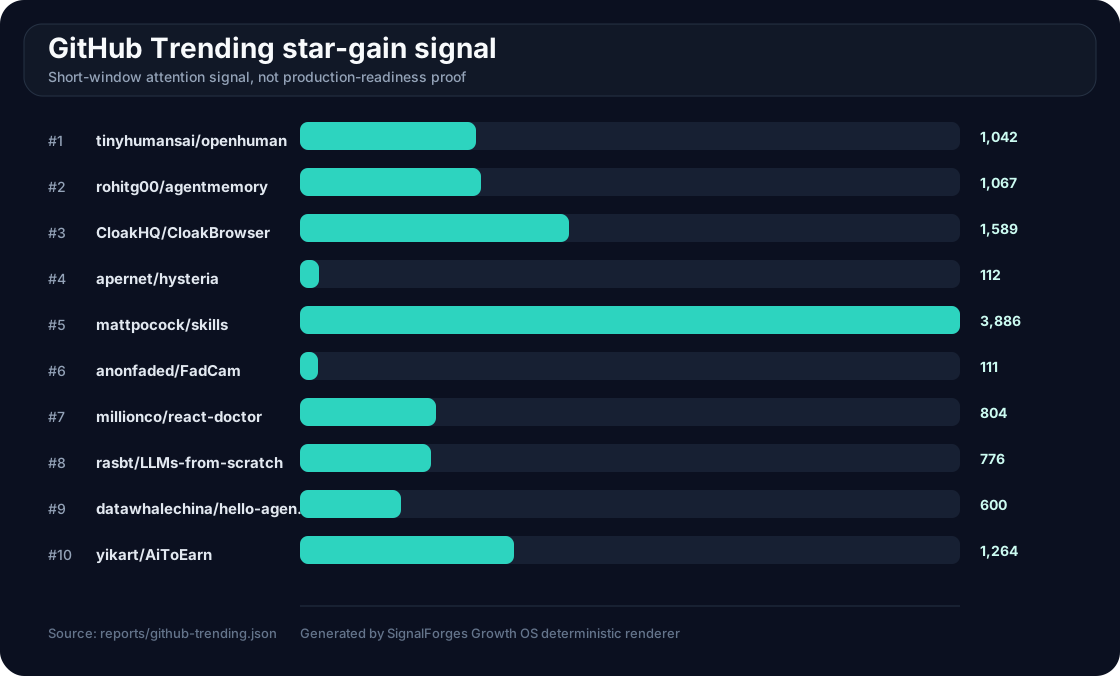
All star counts and push timestamps reflect GitHub API state as of the enrichment window. The "Stars Gained" column represents the daily delta reported by GitHub Trending; it is a short-window attention metric, not a durability signal (GitHub Trending).
Section 06
GitHub Trending star-gain signal
Section 07
Three Trend Clusters
Cluster 1: Agent Memory and Context Persistence
The highest-content-fit repository in this cycle is rohitg00/agentmemory. It addresses a specific pain point: coding agents like Claude Code, Cursor, and Codex CLI lose project context between sessions. Built-in memory mechanisms (CLAUDE.md, .cursorrules) are capped and go stale. Agentmemory provides a persistent memory server built on the iii engine, offering retrieval accuracy, token savings, and session replay. It exposes a REST API bound to localhost by default and integrates via MCP configuration for any MCP-compatible client.
Installation paths include npx @agentmemory/agentmemory for npm users, Docker Compose for containerized setups, and source builds. The repository is active — the most recent commit fixes distroless volume permissions and a viewer proxy issue (commit 5ea01c162cad). The Apache-2.0 license permits commercial use without copyleft obligations. For teams running coding agents across multiple sessions and repositories, this is the repository most likely to reduce context-rebuilding overhead.
tinyhumansai/openhuman also targets agent context but from a different angle. It positions itself as a "Personal AI super intelligence" — a desktop agent harness written in Rust that ingests local files, emails, and search results, then runs them through a feature called TokenJuice for token compression. Binaries are available for macOS and Windows via the project homepage. The comparison table in the README pits OpenHuman against other agent harnesses, though the specific competitors are not named in the available excerpt. The GPL-3.0 license means any
Cluster 2: Agent Skills and Engineering Workflow
mattpocock/skills gained the highest star delta of the day at 3,886, pushing its total to 75,133 — the largest existing community in this ranking. The repository contains opinionated skill definitions that Matt Pocock uses daily with his coding agent, specifically for what he terms "real engineering, not vibe coding."
The README identifies three failure modes with agent-assisted development: the agent doesn't follow intent, the agent is too verbose, and the resulting code doesn't work or creates architectural decay. The skills scaffold addresses these with a set of Shell-based skill definitions installed via skills.sh and activated with a /setup-matt-pocock-skills command in the agent. Skills include engineering workflows (issue triage, domain doc layout) and productivity patterns.
The MIT license and the author's established reputation in the TypeScript community (Total TypeScript) make this a low-risk, high-value inspection target. The repository is not a framework — it does not own the development process. It is a configuration layer that can be adopted incrementally or used as a reference for building custom skill sets.
Cluster 3: Infrastructure with Mixed or Low AI-Dev-Tool Fit
CloakHQ/CloakBrowser is a Chromium fork with source-level fingerprint patches designed to pass bot detection tests. Its README claims 30/30 tests passed and positions it as a drop-in Playwright replacement. Topics listed on the repository include anti-detect, captcha-bypass, and cloudflare-bypass. The editorial risk score is elevated because the tool's primary use case — evading bot detection — has legitimate applications in testing and research but also enables scraping abuse and paywall bypass. This repository is included as risk context; developers sh
apernet/hysteria is a mature QUIC-based proxy focused on censorship resistance. With over 20,000 total stars and a last push on 2026-05-10, it has an established user base and active maintenance. However, its content-fit score for AI developer tooling is the lowest in the ranking. It is a network infrastructure tool, not an agent or AI workflow component. It appears here because it trended, not because it addresses an AI-developer-tool problem.
Section 08
Article illustration

Section 09
Which Repositories Deserve Deeper Inspection
Inspect first: rohitg00/agentmemory. The problem it solves (context loss between coding agent sessions) is concrete and well-scoped. The Apache-2.0 license, npm/Docker install paths, and MCP integration make it adoptable without licensing or infrastructure lock-in. Check the iii engine dependency and local storage model before committing to production use.
Inspect second: mattpocock/skills. Even if you do not adopt the specific skill definitions, the README's articulation of agent failure modes is a useful diagnostic framework. The install path is non-destructive — skills can be evaluated in isolation.
Evaluate cautiously: tinyhumansai/openhuman. The Rust-based agent harness and token compression feature are interesting, but GPL-3.0 copyleft, 98 open issues, and a young codebase mean this is early-adopter territory, not production-ready infrastructure.
Do not inspect for AI dev tool use: apernet/hysteria. It is a capable network proxy, but it does not solve an AI-developer-tool problem.
Section 10
What Not to Infer from GitHub Trending
- High star counts do not indicate code quality. mattpocock/skills has 75,133 total stars partly because of the author's existing audience, not because the repository has been stress-tested in production.
- Daily star deltas are noisy. A single social media mention or newsletter feature can produce the numbers seen here.
- Trending position does not reflect AI-developer-tool fit. apernet/hysteria ranked fourth but has the lowest content-fit score in this analysis.
- Repositories with elevated editorial risk (like CloakHQ/CloakBrowser) can trend without signaling that the tool is appropriate for every developer's use case.
Today's GitHub Trending page returned eleven repositories for the daily window. Of those, five were enriched with full metadata. The signal that matters for AI-infrastructure developers splits into two clusters: persistent memory layers for coding agents, and opinionated skill sc
Best for
Developers evaluating AI infrastructure or coding-assistant tooling.
Avoid when
Treating this page as a substitute for running your own evaluation.
Refresh-sensitive details
- Some claims are refresh-sensitive; verify the primary source before citing specific numbers.
- Automation-assisted publication; SignalForges editors review audit reports after publication.
Source Ledger
These are the primary references used to keep the article grounded. Pricing, limits, benchmark results, and model names are rechecked against the source type shown below.
| Source | Type | How it is used |
|---|---|---|
| GitHub Trending | ecosystem reference | Primary evidence cited inline by the Hermes Writer agent. |
| tinyhumansai/openhuman | ecosystem reference | Primary evidence cited inline by the Hermes Writer agent. |
| rohitg00/agentmemory | ecosystem reference | Primary evidence cited inline by the Hermes Writer agent. |
| CloakHQ/CloakBrowser | ecosystem reference | Primary evidence cited inline by the Hermes Writer agent. |
| apernet/hysteria | ecosystem reference | Primary evidence cited inline by the Hermes Writer agent. |
| mattpocock/skills | ecosystem reference | Primary evidence cited inline by the Hermes Writer agent. |
What This Article Actually Claims
Today's GitHub Trending page returned eleven repositories for the daily window. Of those, five were enriched with full metadata. The signal that matters for AI-infrastructure developers splits into two clusters: persiste
https://github.com/trending
Primary source URLs reachable and cited inline in the article.
SignalForges automated content audit.
No first-person hands-on claims are made unless the fact pack contains reproducible commands.
SignalForges Autonomous Publishing Safety Contract rule 2.
Methodology
- Draft composed by the Hermes Writer agent using the active prompt registry version.
- Claims verified against the linked primary URLs before publication.
- AI assistance was used; no private data or unreleased sources were referenced.
Frequently asked
Questions readers ask
What does this briefing recommend developers do first?
Today's GitHub Trending page returned eleven repositories for the daily window. Of those, five were enriched with full metadata. The signal that matters for AI-infrastructure developers splits into two clusters: persistent memory layers for coding agents, and opinionated skill sc
Where can readers verify the figures cited in this article?
Every precise figure must be verified against the primary URL. The first listed source is https://github.com/trending.
Is this article human-authored or AI-assisted?
The draft was composed with AI assistance by the Hermes Writer agent, then reviewed against the SignalForges editorial policy and the Autonomous Publishing Safety Contract before publication.