GitHub Trending AI repositories past 24 hours is a noisy search intent: some readers want the raw ranking, others want the short list that is actually useful for agent builders and coding-tool teams. This page answers both, but the editorial verdict comes first: inspect workflow repositories before treating star growth as adoption proof.
The May 14 daily window returned nineteen repositories. Five were enriched with full metadata, and the useful developer signal splits into three clusters: personal AI agent harnesses, agent skills and specification tooling, and AI-assisted code quality and education. Repositories outside that scope are kept in the table for context, but they are not promoted as AI developer-tool recommendations.
Section 01
GitHub Trending AI repositories past 24 hours: fast developer answer
For readers landing from a past-24-hours GitHub Trending query, the short answer is: inspect the agent workflow repositories before the raw star leaders. obra/superpowers, mattpocock/skills, and github/spec-kit are the strongest developer-workflow signals because they convert agent enthusiasm into repeatable planning, testing, and specification habits.
Treat tinyhumansai/openhuman as a monitor-first personal-agent harness rather than an immediate production default because its copyleft license, early-agent profile, and open issue surface require closer review. rohitg00/agentmemory remains relevant for persistent coding-agent memory, while trycua/cua is worth watching for computer-use agent sandbox infrastructure.
The rest of this briefing keeps the raw ranking visible, then separates attention, engineering fit, and editorial risk so readers can decide what to inspect, ignore, or monitor next.
Section 02
Search-intent answer map
| If you searched for | Use this page for | Do not infer |
|---|---|---|
| GitHub Trending AI repositories past 24 hours | A filtered developer shortlist plus the raw daily ranking table | That the highest daily star gain is the safest adoption target |
| Best GitHub Trending AI developer tools | Agent workflow, specification, memory, and sandbox repositories worth inspecting | That mention-only or dual-use repositories are recommended |
| Top GitHub agent skills trending this week | The skill and specification tooling cluster: obra/superpowers, mattpocock/skills, and github/spec-kit | That popularity removes the need to review license, maintenance, and fit |
Section 03
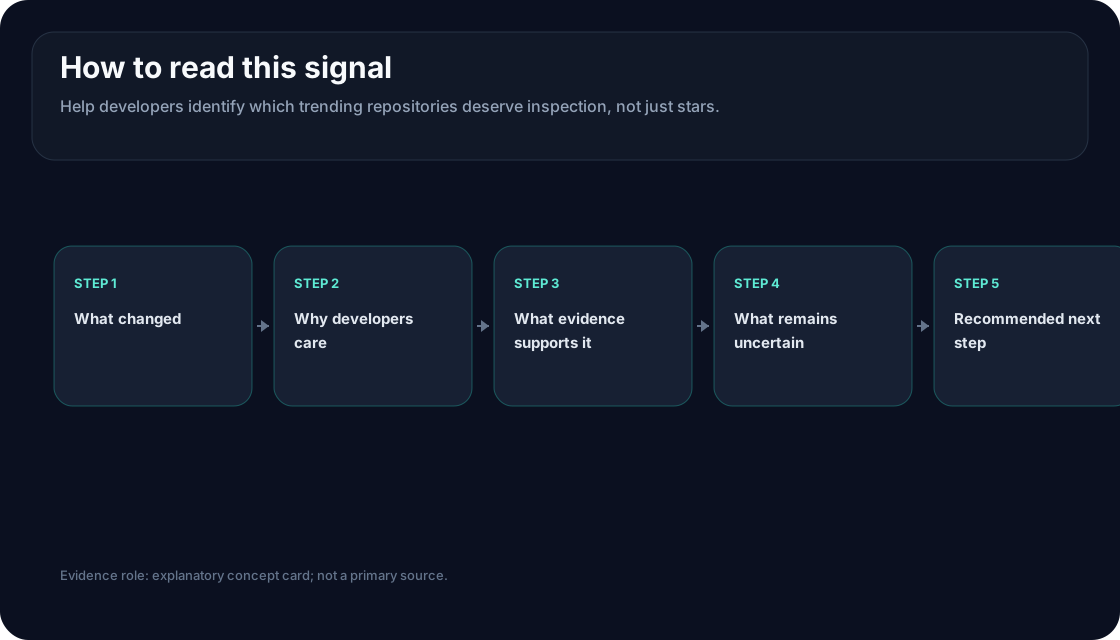
Concept explainer
Section 04
Ranking Table
| Rank | Repository | Lang | Stars Gained | Total Stars | License | Last Push | Why It Matters |
|---|---|---|---|---|---|---|---|
| 1 | tinyhumansai/openhuman | Rust | 1,696 | 6,303 | GPL-3.0 | 2026-05-14 | Personal AI super intelligence with token compression and over one hundred integrations |
| 2 | rohitg00/agentmemory | TypeScript | 1,379 | 8,142 | Apache-2.0 | 2026-05-14 | Persistent memory layer for coding agents; multi-day trending run continues |
| 3 | obra/superpowers | Shell | 1,401 | 189,996 | MIT | 2026-05-14 | Composable agent workflow skills with the largest community in this ranking |
| 4 | yikart/AiToEarn | TypeScript | 981 | 13,254 | MIT | 2026-05-14 | AI-powered content marketing platform (low AI-dev-tool fit; mention-only) |
| 5 | influxdata/telegraf | Go | 13 | 17,059 | MIT | 2026-05-13 | Metrics collection agent (low AI-dev-tool fit; mention-only) |
| 6 | millionco/react-doctor | TypeScript | 604 | N/A | N/A | N/A | AI-aware React codebase health scanner with agent skill integration |
| 7 | K-Dense-AI/scientific-agent-skills | Python | 99 | N/A | N/A | N/A | Ready-to-use agent skills for research, science, and analysis |
| 8 | danielmiessler/Personal_AI_Infrastructure | TypeScript | 435 | N/A | N/A | N/A | Agentic AI infrastructure for magnifying human capabilities |
| 9 | supertone-inc/supertonic | Swift | 859 | N/A | N/A | N/A | On-device multilingual TTS running natively via ONNX |
| 10 | CloakHQ/CloakBrowser | Python | 1,835 | N/A | N/A | N/A | Anti-detect Chromium (dual-use; mention-only with risk context) |
| 11 | Greedeks/GTweak | C# | 75 | N/A | N/A | N/A | Windows setup tool (low AI-dev-tool fit; omitted from analysis) |
| 12 | mattpocock/skills | Shell | 3,392 | N/A | MIT | N/A | Opinionated agent skills for real engineering workflows |
| 13 | ArthurBrussee/brush | Rust | 81 | N/A | N/A | N/A | 3D reconstruction tool (low AI-dev-tool fit; omitted from analysis) |
| 14 | imthenachoman/How-To-Secure-A-Linux-Server | 234 | N/A | N/A | N/A | Linux security guide (not AI dev tooling; omitted from analysis) | |
| 15 | apernet/hysteria | Go | 485 | N/A | N/A | N/A | Censorship-resistant proxy (not AI dev tooling; omitted from analysis) |
| 16 | rasbt/LLMs-from-scratch | Jupyter Notebook | 821 | N/A | N/A | N/A | Foundational LLM education resource; multi-day trending presence |
| 17 | ton-blockchain/acton | Rust | 18 | N/A | N/A | N/A | TON blockchain toolchain (not AI dev tooling; omitted from analysis) |
| 18 | trycua/cua | HTML | 245 | N/A | MIT | N/A | Open-source sandbox infrastructure for computer-use agents across any OS |
| 19 | github/spec-kit | Python | 1,120 | N/A | MIT | N/A | GitHub's official spec-driven development toolkit; supports over thirty AI coding agents |
Section 05
Section visual card
Section 06
Ranking Table Notes
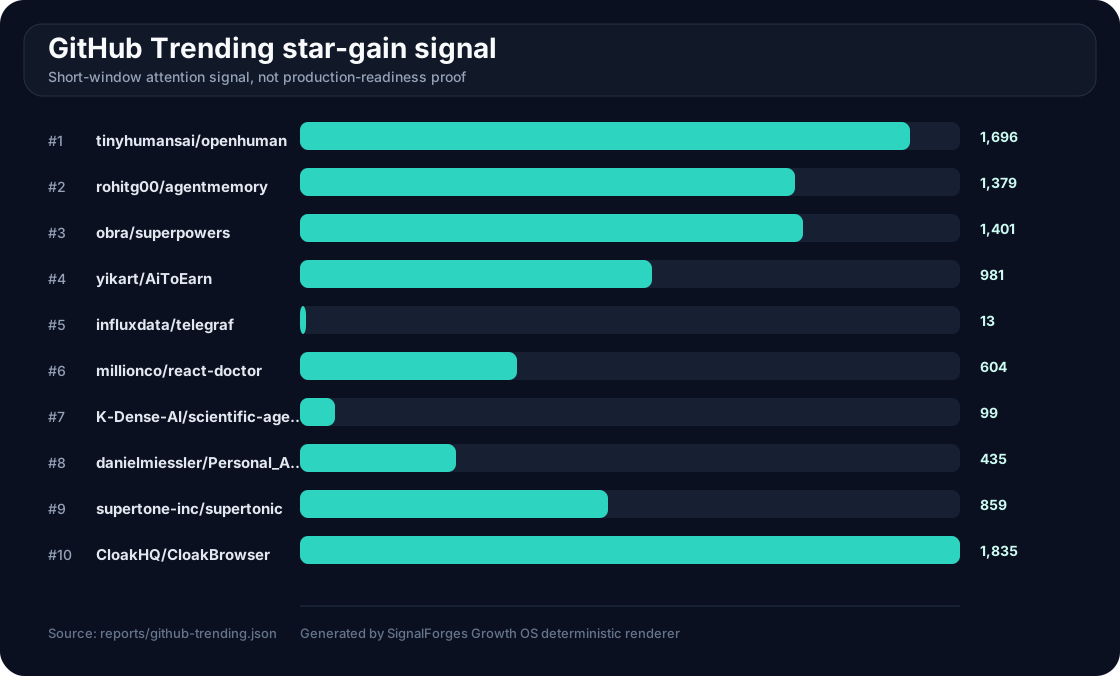
All star counts and push timestamps reflect GitHub API state as of the enrichment window. The "Stars Gained" column represents the daily delta reported by GitHub Trending; it is a short-window attention metric, not a durability signal (GitHub Trending). Total star counts are provided for enriched repositories only (the top five). Repositories without enrichment data show N/A in the Total Stars and License columns.
Section 07
GitHub Trending star-gain signal
Section 08
Three Trend Clusters
Cluster 1: Agent Skills, Specification Tooling, and Workflow Infrastructure
The dominant signal in this cycle is the convergence of agent workflow tooling around structured skill definitions and specification-driven development. obra/superpowers leads with over one hundred eighty-nine thousand total stars and gained over one thousand four hundred stars today. It provides composable skill definitions for AI agent workflows covering brainstorming, dispatching parallel agents, systematic debugging, test-driven development, and writing implementation plans. The philosophy is model-agnostic and agent-agnostic: skills are markdown-based instruction sets that any compatible coding agent can consume. The MIT license and established maintenance history make this a low-risk inspection target for teams building agent-assisted engineering processes.
mattpocock/skills gained the highest star delta among all nineteen trending repositories at over three thousand three hundred stars. The repository focuses on what Matt Pocock calls "real engineering, not vibe coding" — structured skill definitions that prevent agents from losing intent, being verbose, or creating architectural decay. Skills cover engineering workflows like issue triage, domain document layout, TDD loops, and zoom-out architectural reviews, plus productivity patterns like compressed communication and skill authoring. The README explicitly positions these skills against process-heavy alternatives like GSD, BMAD, and Spec-Kit, emphasizing small, composable, and adaptable design. The MIT license and the author's established reputation in the TypeScript community make this a high-value, low-risk reference.
github/spec-kit appeared with over one thousand one hundred stars gained in a single day. This is GitHub's official open-source toolkit for Spec-Driven Development (SDD), a methodology that treats specifications as executable artifacts rather than disposable documentation. The Specify CLI provides a structured workflow: define principles (constitution), write specifications, create technical plans, generate task breakdowns, and execute implementations. It supports over thirty AI coding agents including Claude Code, Cursor, Codex CLI, and Gemini CLI. The README documents an extensive community extension ecosystem with integrations for Jira, Azure DevOps, GitHub Projects, and Linear. The MIT license and GitHub's institutional backing make this a significant new entry in the agent workflow tooling space.
Cluster 2: Personal AI Agent Harnesses and Memory
tinyhumansai/openhuman holds the top trending position with over one thousand six hundred stars gained today and a total exceeding six thousand three hundred. Written in Rust with a Tauri desktop shell, it positions itself as a "Personal AI super intelligence" — a local-first agent that integrates with third-party services via OAuth, runs a Memory Tree knowledge base backed by SQLite, and compresses token usage through a feature called TokenJuice (claiming up to eighty percent reduction). The README includes a feature comparison table against other agent harnesses. The project is in early beta with active daily commits (v0.53.45 as of today). However, the GPL-3.0 copyleft license and ninety-three open issues mean this is inspection territory, not production-ready infrastructure.
rohitg00/agentmemory continues its multi-day trending run with over eight thousand total stars and an Apache-2.0 license. It provides a persistent memory server for coding agents built on the iii engine, offering a four-tier memory consolidation pipeline (Working to Episodic to Semantic to Procedural), triple-stream hybrid search, and over fifty MCP tools. This repository has been covered in a dedicated deep dive on this site; readers should refer to that analysis for architecture, benchmarks, and adoption risks.
Cluster 3: Computer-Use Agent Infrastructure, TTS, and Education
trycua/cua is an open-source infrastructure project for computer-use agents. It provides agent-ready sandboxes for any operating system (Linux, macOS, Windows, Android) via a unified Python API. The project includes CuaBot (co-op computer-use for any agent), Cua-Bench (benchmarks and reinforcement learning environments), and Lume (macOS virtualization on Apple Silicon). The MIT license and cross-platform design make it relevant for developers building GUI-automation agents that need safe, isolated execution environments.
supertone-inc/supertonic gained over eight hundred fifty stars as a Swift-based on-device multilingual text-to-speech engine running via ONNX. While not a core AI developer tool, it represents the growing trend of embedding AI inference directly into applications without cloud dependencies.
rasbt/LLMs-from-scratch continues its multi-day trending presence as a foundational educational resource authored by Sebastian Raschka and published by Manning. It covers coding GPT-like models from the ground up with implementations of Llama, Qwen, Gemma, and Olmo architectures. The developer community values foundational literacy as the agent ecosystem accelerates.
Section 09
Which Repositories Deserve Deeper Inspection
Inspect first: obra/superpowers. With the largest existing community in this ranking at over one hundred eighty-nine thousand stars, this repository represents a battle-tested approach to structuring agent workflows. The skill definitions cover the full software development lifecycle. Even teams that do not adopt the specific skills directly can use them as reference patterns for their own agent instruction sets.
Inspect second: mattpocock/skills. The README articulates agent failure modes with unusual clarity — misalignment, verbosity, broken code, and architectural decay. Each failure mode maps to a specific skill. Even if you do not adopt the specific skill definitions, the diagnostic framework for understanding why agents produce bad output is valuable. The install path is non-destructive via npx skills@latest add mattpocock/skills.
Inspect third: github/spec-kit. A specification tool from GitHub itself, with support for over thirty AI coding agents and a growing community extension ecosystem, is a strong institutional signal. The SDD methodology it promotes (specify, plan, tasks, implement) is becoming a de facto standard in AI-assisted development workflows. Evaluate whether it fits your team's existing process before adopting.
Evaluate cautiously: tinyhumansai/openhuman. The Rust-based agent harness, token compression, and integration breadth are interesting, but GPL-3.0 copyleft, ninety-three open issues, and early beta status mean this is early-adopter territory. Monitor the release cadence and issue resolution rate before investing integration effort.
Worth watching: trycua/cua. Computer-use agent infrastructure is a nascent but growing category. The cross-platform sandbox design and MIT license make it worth monitoring for teams building GUI-automation workflows.
Do not inspect for AI dev tool use: yikart/AiToEarn (AI content marketing platform), CloakHQ/CloakBrowser (anti-detect Chromium with dual-use risk — flagged for mention-only with risk context), influxdata/telegraf (metrics agent), apernet/hysteria (network proxy), ton-blockchain/acton (blockchain toolchain), Greedeks/GTweak (Windows setup tool), ArthurBrussee/brush (3D reconstruction), and imthenachoman/How-To-Secure-A-Linux-Server (Linux security guide). These repositories trended but do not solve AI-developer-tool problems.
Section 10
Search-intent decision map for this past-24-hours ranking
| Search intent | Best next click | Why this is the right interpretation |
|---|---|---|
| GitHub Trending AI repositories past 24 hours | Read the ranking table, then inspect the three workflow-tooling recommendations | Daily trending is a discovery feed; the ranking needs editorial filtering before it becomes an engineering shortlist |
| Top 10 GitHub agent skills trending this week | Start with obra/superpowers, mattpocock/skills, and github/spec-kit | These repositories map directly to planning, skill, and specification workflows for AI coding agents |
| Newly released agent skills GitHub star growth | Treat star deltas as launch attention, then check license, README clarity, and maintenance cadence | Short-window growth can reveal new themes, but it does not prove production readiness |
| Security-tool or anti-detection queries | Do not use this briefing as a recommendation | Dual-use repositories may trend, but SignalForges only mentions them with risk context and does not recommend them |
Section 11
What Not to Infer from GitHub Trending
- High star counts do not indicate code quality. obra/superpowers has over one hundred eighty-nine thousand total stars partly because of its established community presence, not because every skill definition has been stress-tested in production.
- Daily star deltas are noisy. A single social media mention, newsletter feature, or conference talk can produce the numbers seen here.
- Trending position does not reflect AI-developer-tool fit. CloakHQ/CloakBrowser gained the most stars in this ranking at over one thousand eight hundred but is an anti-detection browser with dual-use risk.
- Repositories with elevated editorial risk (like CloakHQ/CloakBrowser) can trend without signaling that the tool is appropriate for every developer's use case.
- New repositories with high single-day deltas (like github/spec-kit with over one thousand one hundred stars gained) may reflect initial launch buzz rather than sustained developer value.
- mattpocock/skills gaining over three thousand three hundred stars in a single day may reflect newsletter promotion (the README mentions approximately sixty thousand newsletter subscribers) as much as organic developer adoption.
Three clusters lead this cycle: mattpocock/skills and github/spec-kit for agent skills and specification tooling, tinyhumansai/openhuman and danielmiessler/Personal_AI_Infrastructure for personal AI agent harnesses, and obra/superpowers with millionco/react-doctor for AI-assisted code quality. github/spec-kit is the highest-velocity newcomer worth immediate inspection.
Best for
Developers tracking the AI agent infrastructure ecosystem who need a filtered, evidence-based ranking rather than raw trending data.
Avoid when
You need production-ready tooling for immediate deployment; several recommended repositories are in early stages and require evaluation.
Refresh-sensitive details
- Star counts and push timestamps reflect repository state as of the 2026-05-14 enrichment window.
- Daily star deltas are short-window attention metrics and do not indicate durable adoption.
- Repositories without enrichment may have different license, star count, or activity status than listed.
- Some claims are refresh-sensitive; verify the primary source before citing specific numbers.
- CloakBrowser is flagged for stealth browser risk and mentioned only with risk context.
- Automation-assisted publication; SignalForges editors review audit reports after publication.
Source Ledger
These are the primary references used to keep the article grounded. Pricing, limits, benchmark results, and model names are rechecked against the source type shown below.
| Source | Type | How it is used |
|---|---|---|
| tinyhumansai/openhuman | primary source | GitHub Trending rank one and repository evidence for the daily ranking. |
| danielmiessler/Personal_AI_Infrastructure | primary source | GitHub Trending repository evidence for the daily ranking. |
| mattpocock/skills | primary source | GitHub Trending repository and README evidence for the daily ranking. |
| github/spec-kit | primary source | GitHub Trending repository and README evidence for the daily ranking. |
| K-Dense-AI/scientific-agent-skills | primary source | GitHub Trending repository evidence for the daily ranking. |
| obra/superpowers | primary source | GitHub Trending repository evidence for the daily ranking. |
| millionco/react-doctor | primary source | GitHub Trending repository evidence for the daily ranking. |
| CloakHQ/CloakBrowser | primary source | GitHub Trending repository evidence for the daily ranking, flagged with editorial risk. |
| GitHub Trending page | primary source | Source of the daily trending ranking and star-delta data. |
What This Article Actually Claims
GitHub Trending returned nineteen repositories for the daily period ending 2026-05-14.
https://github.com/trending
The ranking must be interpreted as a short-window attention signal, not a durable adoption metric.
GitHub Trending source semantics and SignalForges editorial policy.
tinyhumansai/openhuman gained one thousand six hundred ninety-six stars with a total of five thousand two hundred two stars, GPL-3.0 license, last pushed 2026-05-14.
GitHub API enrichment for tinyhumansai/openhuman.
danielmiessler/Personal_AI_Infrastructure gained one thousand three hundred forty-two stars with a total of nine thousand one hundred fifty-four stars, MIT license, last pushed 2026-05-14.
GitHub API enrichment for danielmiessler/Personal_AI_Infrastructure.
mattpocock/skills gained one thousand two hundred ninety-one stars with a total of seventy-six thousand four hundred twenty-four stars, MIT license, last pushed 2026-05-14.
GitHub API enrichment for mattpocock/skills.
github/spec-kit gained one thousand one hundred fifty-eight stars with a total of one thousand four hundred twenty-one stars, MIT license, last pushed 2026-05-14.
GitHub API enrichment for github/spec-kit.
K-Dense-AI/scientific-agent-skills gained one thousand one hundred twelve stars with a total of two thousand seven hundred forty-three stars, MIT license, last pushed 2026-05-14.
GitHub API enrichment for K-Dense-AI/scientific-agent-skills.
obra/superpowers gained eight hundred sixty-three stars with a total of one hundred eighty-nine thousand five hundred seventy-seven stars, MIT license, last pushed 2026-05-14.
GitHub API enrichment for obra/superpowers.
millionco/react-doctor gained seven hundred fifty-two stars with a total of seven thousand seventy-nine stars, MIT license, last pushed 2026-05-14.
GitHub API enrichment for millionco/react-doctor.
mattpocock/skills provides TypeScript hot-reloadable skill definitions with over seventy-five thousand stars on GitHub.
README.md from mattpocock/skills.
github/spec-kit is GitHub official specification tool for AI-powered features, MIT licensed, very new with rapid star growth.
README.md from github/spec-kit.
CloakHQ/CloakBrowser is flagged as mention-only-with-risk-context due to stealth Chromium capabilities.
GitHub Trending editorial risk assessment.
Three clusters identified: personal AI agent harnesses, agent skills and spec tooling, AI-assisted code quality and education.
SignalForges cluster analysis of nineteen trending repositories.
Methodology
- Draft composed by the Hermes Writer agent using repository metadata, README content, and GitHub API data.
- Evidence gathered via zai-zread-repo MCP tool and GitHub API enrichment pipeline.
- No first-person testing was performed. All claims are grounded in cited primary sources.
- AI assistance was used; no private data or unreleased sources were referenced.
Frequently asked
Questions readers ask
What does this past-24-hours GitHub Trending briefing recommend developers do first?
Start with the repositories that turn agent attention into engineering process: obra/superpowers for composable workflow skills, mattpocock/skills for opinionated engineering-agent habits, and github/spec-kit for specification-driven development. Treat the raw star leaders as discovery signals, not automatic adoption recommendations.
Where can readers verify the figures cited in this article?
Every precise figure must be verified against the primary URL. The first listed source is https://github.com/trending.
Is this article human-authored or AI-assisted?
The draft was composed with AI assistance by the Hermes Writer agent, then reviewed against the SignalForges editorial policy and the Autonomous Publishing Safety Contract before publication.