Anthropic shipped Claude Code v2.1.139 with a batch of features that shift the tool from a single-session coding assistant toward a multi-session orchestration layer. The release introduces Agent View, a research-preview command that lists every Claude Code session — running, blocked, or completed — in a single interface. It adds a /goal command that sets a completion condition and lets Claude keep working across turns until the condition is met. And it extends the hook system with an exec form and a continueOnBlock option that give automation builders tighter control over how external tools interact with Claude Code sessions.
This analysis is based exclusively on the official release notes published by Anthropic on GitHub. No hands-on testing claims are made. Every feature description below is grounded in the primary source.
Section 01
Why this release matters for builders
Claude Code has been evolving rapidly from a terminal-based coding assistant into a platform for managing multiple autonomous coding sessions. Version 2.1.139 pushes that trajectory forward with three categories of changes: session orchestration (Agent View and /goal), automation control (hook exec form, continueOnBlock, plugin token cost), and infrastructure reliability (MCP project directory, subagent tracing headers, memory growth cap).
For developers running Claude Code in multi-repo or CI environments, these changes address concrete pain points: not knowing which sessions are active, not being able to set autonomous completion conditions, and not having fine-grained control over how external hooks interact with the coding loop. The bug-fix batch also resolves a deadlock in credential handling and caps HTTP/SSE response bodies to prevent unbounded memory growth.
Section 02
Feature summary from the official release notes
| Feature | Command or config | Developer impact |
|---|---|---|
| Agent View (Research Preview) | claude agents | See every session — running, blocked, or done — in a single list |
| /goal command | /goal <condition> | Set a completion condition; Claude keeps working across turns until it is met |
| /scroll-speed command | /scroll-speed | Tune mouse wheel scroll speed with a live preview |
| Plugin details with token cost | claude plugin details <name> | See a plugin component inventory and projected per-session token cost |
| Transcript view navigation | ? { } v | Keyboard shortcuts for jumping between user prompts and toggling panels |
| Hook exec form | args: string[] | Spawn commands directly without a shell; no quoting needed for path placeholders |
| Hook continueOnBlock | continueOnBlock: true | Feed a PostToolUse hook rejection reason back to Claude and continue the turn |
| MCP project directory | CLAUDE_PROJECT_DIR | MCP stdio servers receive project directory in environment, matching hooks |
| Subagent tracing headers | x-claude-code-agent-id | API requests from subagents carry agent-id and parent-agent-id headers |
| API key feature isolation | Automatic | Remote Control, /schedule, and notification preferences disabled when API key is set |
| VS Code session restore | Cmd/Ctrl+Shift+T | Reopen the most recently closed session tab |
Section 03
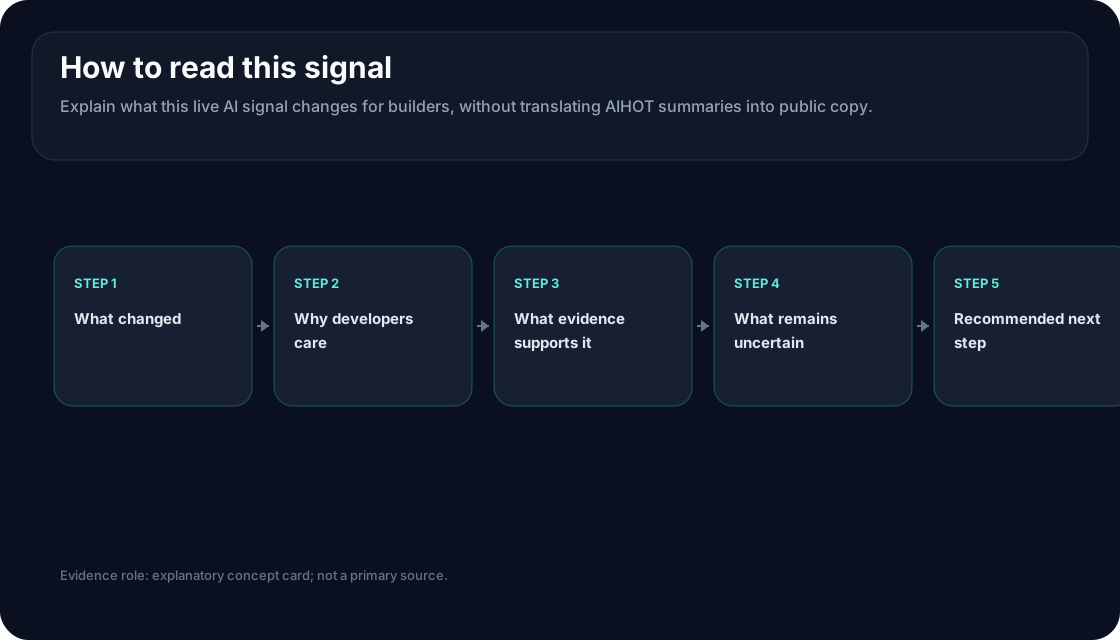
How the new features connect
Section 04
Agent View: from single session to session dashboard
The Agent View command (claude agents) is tagged as a Research Preview, which means the interface and behavior may change. What it provides today is a single list of every Claude Code session across states: running, blocked on user input, or completed. According to the release notes, this covers interactive sessions, -p (print) mode invocations, and Remote Control sessions.
For developers who use Claude Code across multiple repositories or in CI pipelines, this is a visibility upgrade. Previously, managing multiple Claude Code sessions required manual tracking or external tooling. Agent View consolidates session state into one interface, reducing the risk of orphaned sessions or forgotten long-running tasks.
The release notes link to official documentation at code.claude.com/docs/en/agent-view for further details. Because this is a research preview, builders should expect iteration and not yet rely on the exact interface shape for automation scripts.
Section 05
/goal command: autonomous completion across turns
The /goal command introduces a structured way to set a completion condition for Claude Code. Once a goal is set, Claude continues working across multiple turns until the condition is met. The release notes specify that /goal works in interactive mode, -p (print) mode, and Remote Control, and that it shows a live overlay panel with elapsed time, turn count, and token usage.
This is distinct from asking Claude to complete a task in a single prompt. The /goal command explicitly frames the work as multi-turn and autonomous, with the overlay providing real-time observability into how many resources the agent is consuming. For CI or batch processing workflows, this transforms Claude Code from a request-response tool into a goal-driven agent that terminates on its own when the condition is satisfied.
The live elapsed/turns/tokens overlay is particularly relevant for cost management. Builders running Claude Code in automated pipelines can monitor resource consumption without interrupting the agent loop.
Section 06
Hook system upgrades: exec form and continueOnBlock
Claude Code hooks allow external scripts to intercept and respond to tool-use events. Version 2.1.139 adds two significant capabilities to the hook system.
First, the exec form (args: string[]) spawns commands directly without wrapping them in a shell. This eliminates quoting issues with path placeholders, which have been a source of friction when hooks reference files with spaces or special characters in their paths. For automation builders, this means more reliable hook execution across different operating systems and file-system layouts.
Second, the continueOnBlock config option for PostToolUse hooks changes how rejections are handled. Previously, when a PostToolUse hook rejected an action, the turn would stop. With continueOnBlock set to true, the hook rejection reason is fed back to Claude, and the turn continues. This allows Claude to reason about why a hook rejected an action and attempt an alternative approach, rather than simply failing.
Both changes are aimed at builders who integrate Claude Code into larger automation pipelines where hooks enforce security policies, validate outputs, or gate deployments.
Section 07
MCP improvements and plugin token transparency
The release makes two MCP (Model Context Protocol) improvements. MCP stdio servers now receive CLAUDE_PROJECT_DIR in their environment, matching the behavior of hooks. This means plugin configurations can reference ${CLAUDE_PROJECT_DIR} in commands, enabling path-relative server configurations that work across different project directories without manual adjustment.
The /mcp reconnect command now picks up .mcp.json edits without a full restart, and shows the HTTP status and URL when reconnection fails. This reduces friction during development when MCP server configurations change frequently.
Plugin token transparency also improves: claude plugin details <name> now shows a plugin component inventory and projected per-session token cost. The /context all command now accounts for the model tokenizer when estimating per-skill token usage, showing rounded values rather than raw estimates. These changes help builders understand the token budget impact of each plugin and skill before committing to a session configuration.
Section 08
Subagent tracing and API key feature isolation
Two changes affect how Claude Code behaves in multi-agent and enterprise contexts. API requests from subagents now carry x-claude-code-agent-id and x-claude-code-parent-agent-id headers, and claude_code.llm_request OpenTelemetry spans include agent_id and parent_agent_id attributes. This enables observability tooling to trace request lineage across parent-child agent relationships, which is essential for debugging multi-agent workflows and attributing costs to specific agents.
On the feature isolation side, Remote Control, /schedule, claude.ai MCP connectors, and notification preferences are now automatically disabled when ANTHROPIC_API_KEY, apiKeyHelper, or ANTHROPIC_AUTH_TOKEN is set, even if a claude.ai login also exists. This prevents feature conflicts in environments where API-key authentication is the primary access method. The release notes note that unsetting the API key restores these features.
Section 09
Key developer takeaways
Section 10
Bug fixes that matter for production use
The release includes a substantial batch of bug fixes. Several are relevant for builders running Claude Code in production or CI environments:
A deadlock involving expired credentials and the forceRemoteSettingsRefresh policy setting could block claude auth login, logout, and status with no way to recover. This is now fixed.
Unbounded memory growth when an HTTP/SSE MCP server streams non-protocol data is now capped at a 16 MB limit per SSE frame. This prevents resource exhaustion from misbehaving MCP servers.
The autoAllowBashIfSandboxed setting now correctly auto-approves commands containing shell expansions like $VAR and $(cmd), which previously required manual approval despite being in sandboxed mode.
Skill permission rules using the wildcard form Skill(name *) now work as prefix matches, matching the existing Bash(ls *) behavior. Previously, wildcard skill permission rules were incorrectly flagged as unparseable.
Additional fixes address settings hot-reload for symlinked configuration files, MCP resource cleanup for disconnected servers, scroll speed consistency across terminal emulators, and visual rendering issues for CJK characters and emoji in border elements.
Section 11
Developer impact by role
| Developer role | Most relevant features | Practical action |
|---|---|---|
| CI/CD engineer | /goal command, subagent tracing headers | Set completion conditions for automated Claude Code runs; trace agent lineage in observability tooling |
| Security engineer | Hook exec form, continueOnBlock, API key isolation | Tighten hook automation with exec form; use continueOnBlock for policy enforcement that allows agent recovery |
| Platform engineer | Agent View, CLAUDE_PROJECT_DIR, plugin token cost | Monitor all active sessions from one interface; configure MCP servers relative to project directories |
| Plugin developer | Plugin token cost, hook exec form | Show projected token cost for your plugin; use exec form for reliable cross-platform hook execution |
| Individual contributor | /goal, transcript navigation, VS Code session restore | Set goals for complex multi-file tasks; navigate transcripts with keyboard shortcuts; recover closed tabs |
Section 12
What remains uncertain
Agent View is labeled Research Preview, which means the interface, command name, and behavior may change in future releases. Builders should not yet hard-code Agent View output parsing into automation scripts.
The /goal command does not specify how complex or ambiguous conditions are evaluated. Whether Claude can reliably determine that a goal like "all tests pass and the PR is ready for review" is met remains to be seen in practice.
The 16 MB SSE frame cap is a safety measure, but whether it is the right threshold for all MCP server configurations is unclear. Heavily streaming servers may hit the cap frequently.
The continueOnBlock behavior could interact unpredictably with complex hook chains. When a PostToolUse hook rejects an action and Claude retries with an alternative approach, the second attempt may trigger a different hook with its own rejection. Teams with layered hook policies should test the interaction carefully.
API key feature isolation disables Remote Control and /schedule when an API key is present. Teams that use both API-key and claude.ai authentication in the same environment will need to decide which access mode to prioritize.
Section 13
Practical recommendation
If you are running Claude Code in multi-session or CI environments, upgrade to v2.1.139 for the memory growth cap and deadlock fix alone. These are reliability improvements that matter in automated contexts. Then explore Agent View for session visibility and /goal for autonomous task completion, treating both as research-preview capabilities that may evolve.
For teams using hooks to enforce security or compliance policies, the exec form and continueOnBlock options are production-ready improvements that reduce quoting friction and enable more sophisticated rejection handling. Start by migrating existing shell-form hooks to exec form and evaluating continueOnBlock for PostToolUse hooks that currently terminate the turn on rejection.
Section 14
Source ledger and methodology
This analysis is based on the following primary source, accessed on 2026-05-11:
1. "Release v2.1.139" by Anthropic, published on GitHub at https://github.com/anthropics/claude-code/releases/tag/v2.1.139
All feature descriptions, command names, configuration options, and bug-fix details are cited directly from the official release notes. No hands-on testing was performed by SignalForges. No claims about performance, reliability, or user experience beyond what the release notes state are made. Feature descriptions tagged as Research Preview should be treated as subject to change.
Upgrade to v2.1.139 for the memory growth cap and deadlock fix if running Claude Code in production or CI. Explore Agent View and /goal as research-preview capabilities. Migrate hooks to exec form and evaluate continueOnBlock for automation pipelines.
Best for
Developers and engineering teams using Claude Code in multi-session, CI, or automated environments who need session visibility, autonomous completion, and tighter hook control.
Avoid when
Do not hard-code Agent View output parsing into automation scripts while it remains in Research Preview. Do not assume /goal conditions will be evaluated reliably for complex or ambiguous goals without testing.
Refresh-sensitive details
- Agent View is a Research Preview feature. The command name, interface, and behavior may change in future Claude Code releases.
- The /goal command evaluation criteria for complex conditions are not specified in the release notes. Reliability for ambiguous goals is untested.
- The 16 MB SSE frame cap may be insufficient for heavily streaming MCP servers. Teams should monitor whether the cap is hit frequently in their configurations.
- continueOnBlock may interact unpredictably with layered hook chains. Teams with complex hook policies should test the behavior before relying on it in production.
- API key feature isolation disables Remote Control and /schedule when an API key is set. Teams using both authentication modes will need to choose one.
- This article is based on a single primary source (the Anthropic GitHub release notes). No corroborating secondary sources were used.
Source Ledger
These are the primary references used to keep the article grounded. Pricing, limits, benchmark results, and model names are rechecked against the source type shown below.
| Source | Type | How it is used |
|---|---|---|
| Anthropic GitHub Release: Claude Code v2.1.139 | official product | Primary source for all feature descriptions, command names, configuration options, and bug-fix details in this article. |
| Claude Code Agent View documentation | official docs | Official documentation for the Agent View research-preview feature linked from the v2.1.139 release notes. |
| anthropics/claude-code GitHub repository | official product | Repository context for Claude Code as an agentic coding tool: project identity, description, and version history. |
What This Article Actually Claims
Claude Code v2.1.139 adds Agent View (Research Preview) accessible via claude agents, providing a single list of every session.
Anthropic release notes for v2.1.139 on GitHub.
The /goal command sets a completion condition and Claude keeps working across turns until it is met, with a live overlay showing elapsed time, turns, and tokens.
Anthropic release notes for v2.1.139 on GitHub.
Hook args: string[] field provides exec form that spawns commands directly without a shell, so path placeholders never need quoting.
Anthropic release notes for v2.1.139 on GitHub.
Hook continueOnBlock config option for PostToolUse feeds the hook rejection reason back to Claude and continues the turn.
Anthropic release notes for v2.1.139 on GitHub.
MCP stdio servers receive CLAUDE_PROJECT_DIR in their environment, matching hooks. Plugin configs can reference ${CLAUDE_PROJECT_DIR} in commands.
Anthropic release notes for v2.1.139 on GitHub.
API requests from subagents carry x-claude-code-agent-id and x-claude-code-parent-agent-id headers.
Anthropic release notes for v2.1.139 on GitHub.
Remote Control, /schedule, claude.ai MCP connectors, and notification preferences are disabled when ANTHROPIC_API_KEY / apiKeyHelper / ANTHROPIC_AUTH_TOKEN is set.
Anthropic release notes for v2.1.139 on GitHub.
Unbounded memory growth from HTTP/SSE MCP servers streaming non-protocol data is now capped at a 16 MB limit per SSE frame.
Anthropic release notes for v2.1.139 on GitHub.
autoAllowBashIfSandboxed now auto-approves commands with shell expansions like $VAR and $(cmd).
Anthropic release notes for v2.1.139 on GitHub.
Skill(name *) permission rules now work as prefix matches, matching Bash(ls *) behavior.
Anthropic release notes for v2.1.139 on GitHub.
A deadlock involving expired credentials and forceRemoteSettingsRefresh that blocked claude auth login/logout/status is now fixed.
Anthropic release notes for v2.1.139 on GitHub.
claude plugin details <name> shows plugin component inventory and projected per-session token cost.
Anthropic release notes for v2.1.139 on GitHub.
Compaction prompt now asks the model to preserve sensitive user instructions.
Anthropic release notes for v2.1.139 on GitHub.
VS Code extension supports Cmd/Ctrl+Shift+T to reopen the most recently closed session tab.
Anthropic release notes for v2.1.139 on GitHub.
Methodology
- Analysis based exclusively on the official Anthropic release notes for Claude Code v2.1.139, published on GitHub and accessed on 2026-05-11.
- No hands-on testing was performed. Every feature description, command name, and configuration option is cited directly from the release notes.
- Agent View is labeled Research Preview by Anthropic; its interface and behavior may change in future releases.
- No claims about performance, reliability, or user experience beyond what the release notes state are made.
- Developer impact analysis is based on SignalForges editorial assessment of the feature changes for different developer roles.
Frequently asked
Questions readers ask
What is Claude Code Agent View?
Agent View is a research-preview feature in Claude Code v2.1.139 that provides a single list of every Claude Code session — running, blocked on user input, or completed. Run claude agents to access it. Because it is a research preview, the interface may change in future releases.
What does the /goal command do in Claude Code?
The /goal command sets a completion condition, and Claude keeps working across multiple turns until the condition is met. It works in interactive mode, -p mode, and Remote Control. A live overlay panel shows elapsed time, turn count, and token usage while the goal is being pursued.
What is the hook exec form in Claude Code v2.1.139?
The hook exec form (args: string[]) spawns commands directly without wrapping them in a shell. This eliminates quoting issues with path placeholders that contain spaces or special characters. It is useful for automation hooks that reference file paths.
What is continueOnBlock in Claude Code hooks?
continueOnBlock is a new config option for PostToolUse hooks. When set to true, if the hook rejects an action, the rejection reason is fed back to Claude and the turn continues, allowing Claude to try an alternative approach instead of simply failing.
What bug fixes are included in Claude Code v2.1.139?
Key fixes include: a deadlock in credential handling with forceRemoteSettingsRefresh, unbounded memory growth from MCP SSE servers (now capped at 16 MB per frame), autoAllowBashIfSandboxed not working with shell expansions, wildcard skill permission rules not working as prefix matches, and multiple terminal rendering and scrolling fixes.