addyosmani/agent-skills appeared at rank #3 on GitHub Trending on May 10, 2026, gaining +1,092 stars in a single day. The repository is not a framework, a runtime, or an API — it is a curated collection of 20 structured Markdown skill files, 3 agent personas, 4 reference checklists, 7 slash commands, and session lifecycle hooks, all designed to make AI coding agents follow the same engineering discipline that senior software engineers bring to production code.
This deep dive evaluates what the project does (based on README and repository evidence), how it is structured, what it does well, where the limitations are, and whether it is worth your inspection time. It does not contain hands-on testing claims or fabricated benchmarks — only source-backed observations and editorial judgment.
Section 01
Verdict: worth inspecting as a process reference, not a runtime dependency
agent-skills solves a real problem: AI coding agents default to the shortest path, which often means skipping specs, tests, security reviews, and the practices that make software reliable. This repository packages production-grade engineering workflows into structured Markdown files that agents can load as context.
The strongest reason to inspect it is architectural: it demonstrates how to encode process discipline into agent behavior. The 20 skills follow a consistent anatomy (frontmatter, overview, process steps, anti-rationalization tables, red flags, verification checklists) that is well-designed for agent consumption and progressive disclosure.
The main limitation is that these are instruction files, not executable code. Their effectiveness depends entirely on the agent runtime that loads them. If your agent ignores a step, the skill cannot enforce compliance. The repository also focuses on single-agent workflows rather than multi-agent orchestration.
Section 02
Article illustration: skill-driven agent development

Section 03
What the project does, based on README evidence
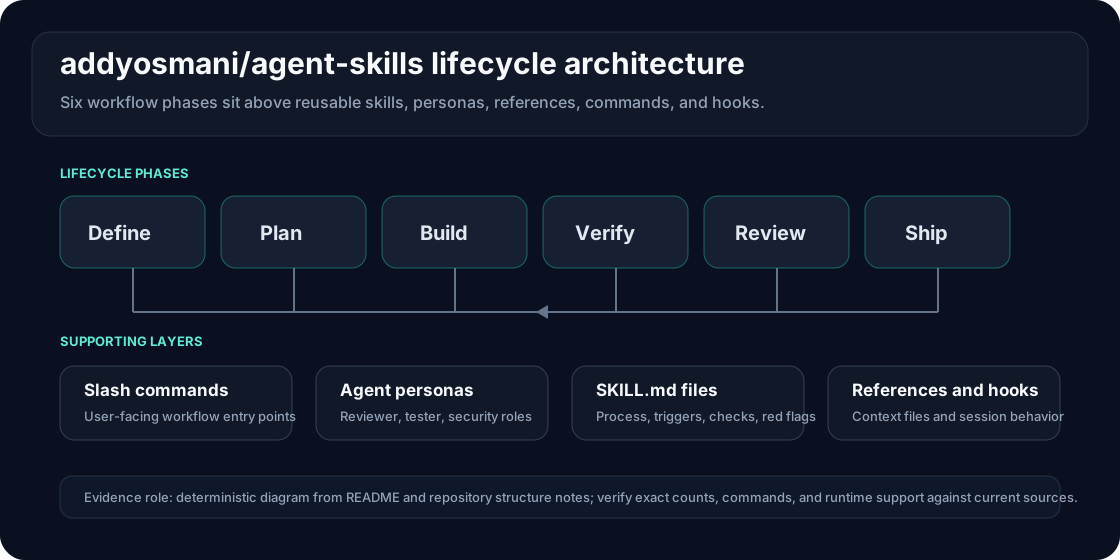
According to the README, agent-skills provides "production-grade engineering skills for AI coding agents." The project maps the software development lifecycle into six phases — Define, Plan, Build, Verify, Review, and Ship — each activated by a slash command (/spec, /plan, /build, /test, /review, /ship) or triggered automatically based on the task context.
The repository contains 20 skills organized across these phases. For example, the "Define" phase includes idea-refine (structured divergent/convergent thinking) and spec-driven-development (write a PRD before code). The "Build" phase includes incremental-implementation (thin vertical slices), test-driven-development (red-green-refactor cycle), context-engineering (feed agents the right information at the right time), and source-driven-development (ground framework decisions in official documentation).
Each skill follows a documented anatomy: YAML frontmatter with name and description, overview, trigger conditions, step-by-step process, anti-rationalization tables, red flags, and verification requirements. The README explicitly states that skills are "process, not prose" — they are workflows agents follow, not reference docs.
The project also includes 3 agent personas (code-reviewer, test-engineer, security-auditor), 4 reference checklists (testing patterns, security, performance, accessibility), and session lifecycle hooks for caching and context management.
Section 04
Repository architecture overview
Section 05
Architecture and workflow interpretation
The repository is a Claude Code plugin — a packaged collection of engineering skills, agent personas, lifecycle hooks, and orchestration commands. However, it also supports Cursor, Gemini CLI, Windsurf, OpenCode, GitHub Copilot, Kiro IDE, and Codex, because the skills are plain Markdown files that work with any agent accepting system prompts or instruction files.
The three-layer architecture is documented in the README: commands (the "when") orchestrate personas (the "who") which invoke skills (the "how"). Slash commands are user-facing entry points; personas define roles with a single perspective; skills define the step-by-step workflows.
The meta-skill "using-agent-skills" is special — it serves as the session-start hook that injects the skill discovery flowchart into every session. This flowchart maps task types to skill names, so agents can self-select the right skill without user intervention.
The anti-rationalization design is architecturally distinctive. Every skill includes a table of common excuses agents use to skip steps, paired with documented counter-arguments. For example, the test-driven-development skill rebuts "I will write tests later" with "You will not. And tests written after the fact test implementation, not behavior." This is a design pattern worth borrowing even if you do not use the repository directly.
Section 06
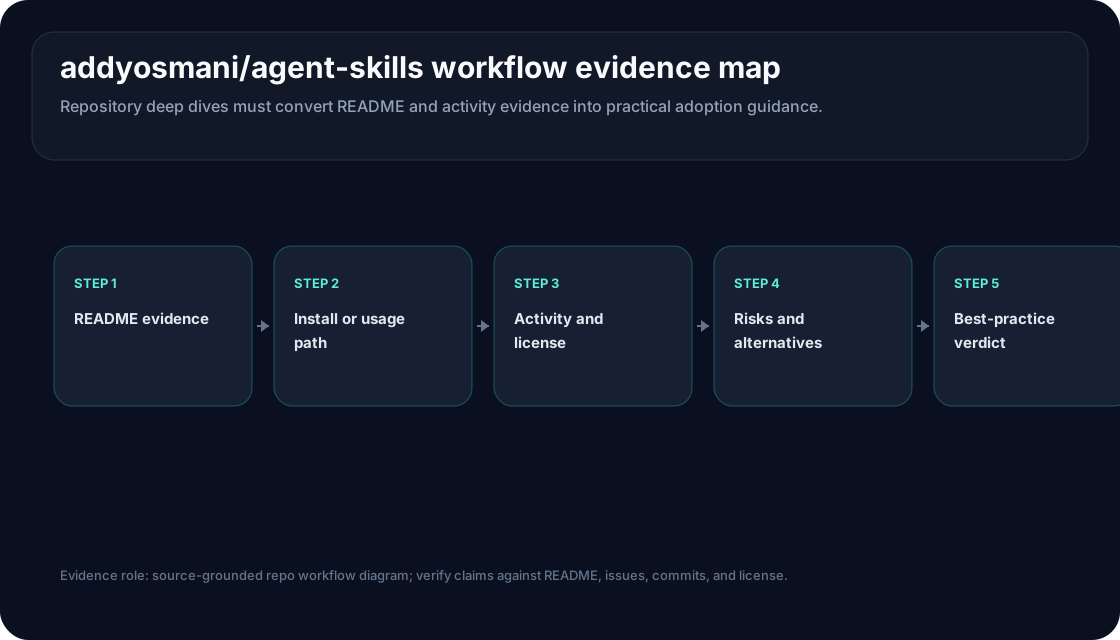
Skill anatomy and lifecycle workflow
Section 07
Repository fact card
| Attribute | Value | Source |
|---|---|---|
| Repository | addyosmani/agent-skills | GitHub API metadata |
| License | MIT | GitHub API repository metadata |
| Language (primary) | Shell (skill files are Markdown) | GitHub API repository metadata |
| Latest push detected | 2026-05-09T21:55:43Z | GitHub API repository metadata |
| Trending rank (May 10) | #3 daily | GitHub Trending snapshot |
| Star gain (daily) | +1,092 | GitHub Trending snapshot |
| Skills count | 20 structured skill directories | Repository structure inspection |
| Agent personas | 3 (code-reviewer, test-engineer, security-auditor) | Repository structure inspection |
| Reference checklists | 4 (testing, security, performance, accessibility) | Repository structure inspection |
| Slash commands | 7 (/spec, /plan, /build, /test, /review, /code-simplify, /ship) | README documentation |
| Supported agent runtimes | Claude Code, Cursor, Gemini CLI, Windsurf, OpenCode, Copilot, Kiro, Codex | README Quick Start section |
| Hooks | Session start, SDD cache, simplify-ignore | Repository hooks/ directory |
Section 08
Skill concept explained
Section 09
Install and first-test path
The README documents multiple installation paths. For Claude Code (the recommended runtime), the primary method is the plugin marketplace: /plugin marketplace add addyosmani/agent-skills followed by /plugin install agent-skills@addy-agent-skills. There is also a local development path: clone the repository and run claude --plugin-dir /path/to/agent-skills.
For Gemini CLI, the install command is gemini skills install https://github.com/addyosmani/agent-skills.git --path skills. For Cursor, Copilot, Windsurf, and other runtimes, the setup involves copying SKILL.md files into the tool-specific rules or instructions directory. Each runtime has a dedicated setup guide in the docs/ directory.
There is no automated test suite or CI pipeline documented in the repository. Skills are Markdown files, so verification happens at the agent-behavior level, not at a unit-test level. This means the "first test" is loading a skill and observing whether the agent follows its process — which is inherently subjective.
Section 10
Best practices and operational guardrails
Based on the repository structure and README evidence, several design patterns are worth extracting for any team building agent workflow discipline:
First, progressive disclosure: the SKILL.md is the entry point, and supporting references load only when needed, keeping token usage minimal. This is a practical concern for any agent that operates under context-window constraints.
Second, the anti-rationalization pattern: every skill explicitly documents the common excuses agents use to skip steps, with rebuttals. This is a novel design approach that addresses the real problem of agent shortcut behavior, and it can be adopted independently of the repository.
Third, the verification-is-non-negotiable principle: every skill ends with evidence requirements. The README states that "seems right is never sufficient." This is the engineering discipline that separates production-quality agent behavior from prototype-quality output.
Fourth, the Beyonce Rule from the test-driven-development skill: "If you liked it, you should have put a test on it." Infrastructure changes, refactoring, and migrations are not responsible for catching bugs — tests are. This is a Google engineering practice adapted for agent context.
Fifth, the skill anatomy contract (frontmatter → overview → triggers → process → rationalizations → red flags → verification) provides a reusable template for encoding any engineering workflow into agent-consumable instructions.
Section 11
Best practices at a glance
Section 12
Alternatives and when to look elsewhere
agent-skills is one approach to agent workflow discipline. Alternatives worth considering include:
Custom system prompts or rules files (Cursor rules, Claude CLAUDE.md, Windsurf rules) give you direct control without a skill-pack abstraction layer. If your team already has strong engineering practices documented, encoding them into your existing rules files may be simpler than adopting an external skill pack.
Framework-level guardrails (like OpenAI structured outputs, Anthropic tool use constraints, or agent frameworks like LangGraph, CrewAI) enforce behavior at the runtime level, not the instruction level. These are stronger guarantees because the agent cannot skip a step, but they require more setup and may not cover process discipline.
Internal team playbooks (Google-style eng-practices documents, team-specific review checklists) are the traditional approach. They work well for human engineers but are not optimized for agent consumption. agent-skills essentially formalizes this kind of playbook into agent-optimized Markdown.
When to avoid agent-skills: if your agent runtime does not support instruction files or skill loading, if you need runtime-level enforcement rather than instruction-level guidance, or if your team already has a mature agent discipline framework that covers the same ground.
Section 13
Risks and limitations
The primary risk is the instruction-enforcement gap: skills are Markdown instructions, not executable constraints. An agent can read a skill and still skip steps, produce shallow output, or ignore verification requirements. The effectiveness depends on the agent runtime, the context window, and how well the skill is written.
The repository is authored primarily by Addy Osmani (a well-known Google engineer), which gives it strong credibility for engineering practices. However, the project is relatively new and the skill library may evolve rapidly. Skills that are useful today may change in structure or scope.
Token consumption is a practical concern. Loading a full skill file into context takes tokens away from the actual task. The progressive disclosure design helps, but teams working with smaller context windows may find the overhead significant.
The repository does not include automated tests, CI pipelines, or versioned releases in the traditional sense. "Working" means the agent follows the skill process, which is inherently subjective and difficult to measure consistently.
Multi-agent orchestration is not a primary focus. The skills are designed for single-agent workflows, which limits their applicability for teams running complex multi-agent pipelines where skill coordination across agents is needed.
Section 14
Methodology and disclosure
This article was produced by an AI editorial agent (Hermes/GLM-5.1) operating under the SignalForges Growth OS gated publishing workflow. The evidence comes from the GitHub repository README, repository structure inspection via the zread-repo MCP tool, and the GitHub Trending daily snapshot for May 10, 2026.
No hands-on testing was performed. The article does not claim that the author ran, installed, or evaluated the software in a live environment. All observations are based on publicly available repository evidence.
Numeric claims (star count, skill count, persona count, command count) are sourced from the repository structure and README documentation as of the collection timestamp. These values may change after publication.
The editorial focus is on helping a technical reader decide whether to invest inspection time, not on recommending adoption. The verdict reflects an editorial judgment about inspection value, not a product endorsement.
Section 15
Refresh-sensitive notes
GitHub Trending rankings change daily. The rank #3 position and star-gain figure are specific to the May 10, 2026 daily snapshot and will not remain stable.
The repository was last pushed to on 2026-05-09T21:55:43Z based on the collected metadata. New commits may have been made after the snapshot was taken.
The skill count (20), persona count (3), and command count (7) are based on the repository structure at the time of inspection. The repository is under active development and these counts may increase.
The supported runtimes list is based on the README Quick Start section. Additional runtimes may be added as the project evolves.
Inspect agent-skills as a process reference and pattern library for encoding engineering discipline into AI coding agents. Borrow the anti-rationalization pattern, skill anatomy contract, and progressive disclosure design even if you do not adopt the skill pack directly.
Best for
Engineering teams and individual developers who want to bring structured workflow discipline to their AI coding agent sessions, especially teams using Claude Code, Cursor, or Gemini CLI.
Avoid when
Avoid if you need runtime-level enforcement rather than instruction-level guidance, if your agent runtime does not support instruction files, or if your team already has a mature agent discipline framework.
Refresh-sensitive details
- Skills are Markdown instructions, not executable constraints. Agent compliance is not guaranteed and depends on the runtime and context window.
- The project is relatively new and the skill library may evolve rapidly. Counts and structure details are refresh-sensitive.
- No automated test suite or CI pipeline is documented. Verification of skill effectiveness is subjective.
- GitHub Trending rank and star-gain figures are specific to the May 10, 2026 daily snapshot and will not remain stable.
Source Ledger
These are the primary references used to keep the article grounded. Pricing, limits, benchmark results, and model names are rechecked against the source type shown below.
| Source | Type | How it is used |
|---|---|---|
| addyosmani/agent-skills GitHub repository | official product | Primary repository identity, public metadata, and project framing. |
| addyosmani/agent-skills README | official docs | Primary evidence for purpose, install path, usage, supported runtimes, skill anatomy, and project structure. |
| addyosmani/agent-skills repository structure | official docs | Directory listing for skills/, agents/, references/, hooks/, and docs/ used to verify file and directory counts. |
| addyosmani/agent-skills CONTRIBUTING.md | official docs | Contribution guidelines and skill quality bar evidence. |
| GitHub Trending daily snapshot 2026-05-10 | ecosystem reference | Trending rank #3, star-gain +1,092, and daily window context. |
What This Article Actually Claims
addyosmani/agent-skills appeared at rank #3 on GitHub Trending daily for May 10, 2026, gaining +1,092 stars.
GitHub Trending daily snapshot collected by Growth OS collect_github_trending.py on 2026-05-10.
The repository is licensed under MIT.
GitHub API repository metadata.
The latest detected push time is 2026-05-09T21:55:43Z.
GitHub API repository metadata.
The repository contains 20 skills (structured as skill directories), 3 agent persona files, 4 reference checklists, 7 slash commands, and session lifecycle hooks.
Repository structure inspection via zread-repo MCP tool.
The project supports Claude Code, Cursor, Gemini CLI, Windsurf, OpenCode, GitHub Copilot, Kiro IDE, and Codex.
README Quick Start section.
Skills follow a consistent anatomy: YAML frontmatter, overview, trigger conditions, step-by-step process, anti-rationalization tables, red flags, and verification checklists.
README skill anatomy documentation and docs/skill-anatomy.md.
The project is authored primarily by Addy Osmani and incorporates Google engineering practices including Hyrum's Law, the Beyonce Rule, trunk-based development, and shift-left CI/CD.
README "Why Agent Skills" section.
Methodology
- Evidence comes from the GitHub repository README, repository structure inspection via the zread-repo MCP tool, and the GitHub Trending daily snapshot for May 10, 2026.
- No hands-on testing was performed. The article does not claim installation, execution, or evaluation in a live environment.
- Numeric claims (star count, skill count, persona count, command count) are sourced from the repository structure and README as of the collection timestamp. These values may change after publication.
- The editorial focus is on inspection value, not adoption recommendation. The verdict reflects editorial judgment about whether the repository is worth a reader's inspection time.
Frequently asked
Questions readers ask
Is agent-skills a framework or a library?
Neither. agent-skills is a collection of structured Markdown instruction files (skills), agent persona definitions, reference checklists, and session hooks. It does not include executable code, runtime dependencies, or API integrations. Skills are loaded as context into agent sessions to guide behavior.
Which AI coding agents does it support?
According to the README, agent-skills supports Claude Code (recommended, via plugin marketplace), Cursor, Gemini CLI, Windsurf, OpenCode, GitHub Copilot, Kiro IDE, and Codex. The skills are plain Markdown, so they work with any agent that accepts system prompts or instruction files.
Can skills enforce that an agent follows the process?
No. Skills are instruction-level guidance, not runtime-level enforcement. An agent can read a skill and still skip steps or produce shallow output. The anti-rationalization tables and verification checklists are designed to discourage shortcut behavior, but they cannot prevent it. For stronger guarantees, consider framework-level constraints or tool-use boundaries.
What is the anti-rationalization pattern?
Each skill includes a table of common excuses that AI agents use to skip process steps (for example, "I will write tests later" or "This is too simple to test"), paired with documented counter-arguments. The pattern addresses the real problem of agent shortcut behavior by preemptively rebutting the rationalizations agents commonly produce.
How does this differ from writing custom system prompts?
Custom system prompts are ad-hoc and team-specific. agent-skills provides a structured, consistent anatomy for encoding engineering workflows (frontmatter → overview → triggers → process → rationalizations → red flags → verification), along with 20 pre-built skills covering the full development lifecycle. The structure is designed for progressive disclosure and agent-optimized consumption.