Today's GitHub Trending snapshot returned nineteen repositories for the daily window. The useful signal is not raw popularity; it is the concentration of agent-facing infrastructure: Claude Code plugins, code knowledge graphs, skill libraries, MCP integrations, and workflow scaffolds for coding agents.
This ranking treats Trending as a short-window attention feed. It recommends inspection paths, not production adoption. Star gains, rank positions, licenses, and push timestamps reflect the collection window and should be rechecked before any team standardizes on a repository.
Section 01
TL;DR: the signal is agent workflow infrastructure, not a generic AI repo list
The strongest developer signal today is the move from single-agent prompts toward reusable operating surfaces. Anthropic's plugin directory, CodeGraph's local code index, Karpathy-inspired guidance files, .NET agent skills, and Superpowers all point at the same problem: teams are trying to make AI coding agents more repeatable, safer to steer, and easier to inspect.
Inspect first if your team uses Claude Code, Cursor, Codex CLI, Copilot, or OpenCode: anthropics/claude-plugins-official for marketplace structure and trust warnings, colbymchenry/codegraph for local code knowledge graphs, and dotnet/skills for domain-specific agent skills in a mature language ecosystem. Watch ChromeDevTools/chrome-devtools-mcp because browser debugging is becoming a natural MCP surface for coding agents, even though this snapshot did not include enriched metadata for it.
Do not read the ranking as a quality leaderboard. Several repositories gained large attention bursts without enough repository evidence in this packet to justify a deep adoption recommendation. Use the table to triage where to spend inspection time, then verify the README, license, recent commits, issue surface, and install path before using any tool on real code.
Section 02
GitHub Trending star-gain signal
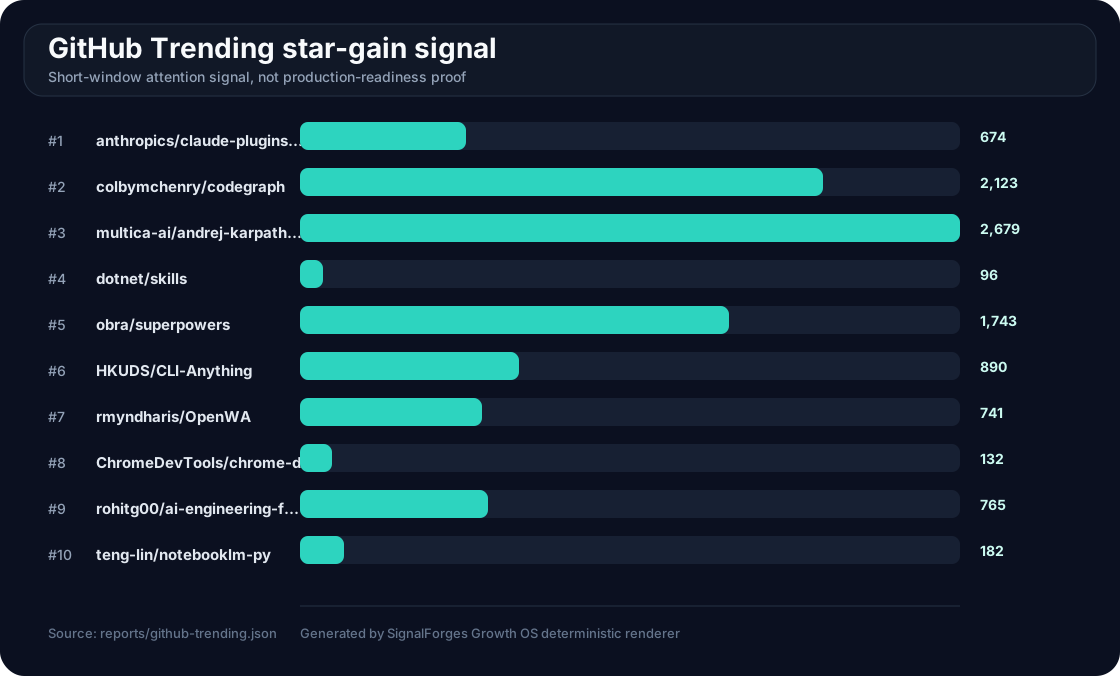
Section 03
Ranking table: May 21 2026 AI developer tooling candidates
| Rank | Repository | Language | Gained stars | License | Pushed at | Why it matters |
|---|---|---|---|---|---|---|
| 1 | anthropics/claude-plugins-official | Python | +674 | Not declared | 2026-05-21T08:36:50Z | Official Anthropic-managed Claude Code plugin directory with plugin structure, installation guidance, and explicit trust warnings. |
| 2 | colbymchenry/codegraph | TypeScript | +2,123 | MIT | 2026-05-20T23:43:25Z | Local code knowledge graph for Claude Code, Cursor, Codex CLI, and OpenCode; useful to inspect for codebase-navigation workflows. |
| 3 | multica-ai/andrej-karpathy-skills | Not specified | +2,679 | Not declared | 2026-04-20T10:05:04Z | Single CLAUDE.md guidance file organized around reasoning before coding, simplicity, surgical edits, and goal-driven execution. |
| 4 | dotnet/skills | C# | +96 | MIT | 2026-05-21T11:14:53Z | Curated .NET team skills and custom agents for coding agents, including installation paths for plugins, VS Code preview support, Codex skills, and agentic workflows. |
| 5 | obra/superpowers | Shell | +1,743 | MIT | 2026-05-14T23:32:25Z | Agentic skills framework and software development methodology; inspect as a mature skill-pattern reference rather than a magic layer. |
| 6 | HKUDS/CLI-Anything | Python | +890 | Not enriched | Not enriched | Claims an agent-native CLI conversion direction; needs README and license verification before recommendation. |
| 7 | rmyndharis/OpenWA | TypeScript | +741 | Not enriched | Not enriched | Self-hosted WhatsApp gateway; tangential to AI developer tools unless used as an agent integration surface. |
| 8 | ChromeDevTools/chrome-devtools-mcp | TypeScript | +132 | Not enriched | Not enriched | Browser debugging through MCP is strategically relevant for coding agents; inspect docs before adoption. |
| 9 | rohitg00/ai-engineering-from-scratch | Python | +765 | Not enriched | Not enriched | Educational AI engineering material; useful for learning context, not necessarily agent infrastructure. |
| 10 | teng-lin/notebooklm-py | Python | +182 | Not enriched | Not enriched | Unofficial NotebookLM API and agentic skill; verify product terms and maintenance boundaries before use. |
| 11 | can1357/oh-my-pi | TypeScript | +270 | Not enriched | Not enriched | Terminal coding-agent harness with hash-anchored edit claims; needs direct README inspection. |
| 12 | antoinezambelli/forge | Python | +449 | Not enriched | Not enriched | Self-hosted LLM tool-calling and multi-step workflow framework; promising but not enriched in this packet. |
Section 04
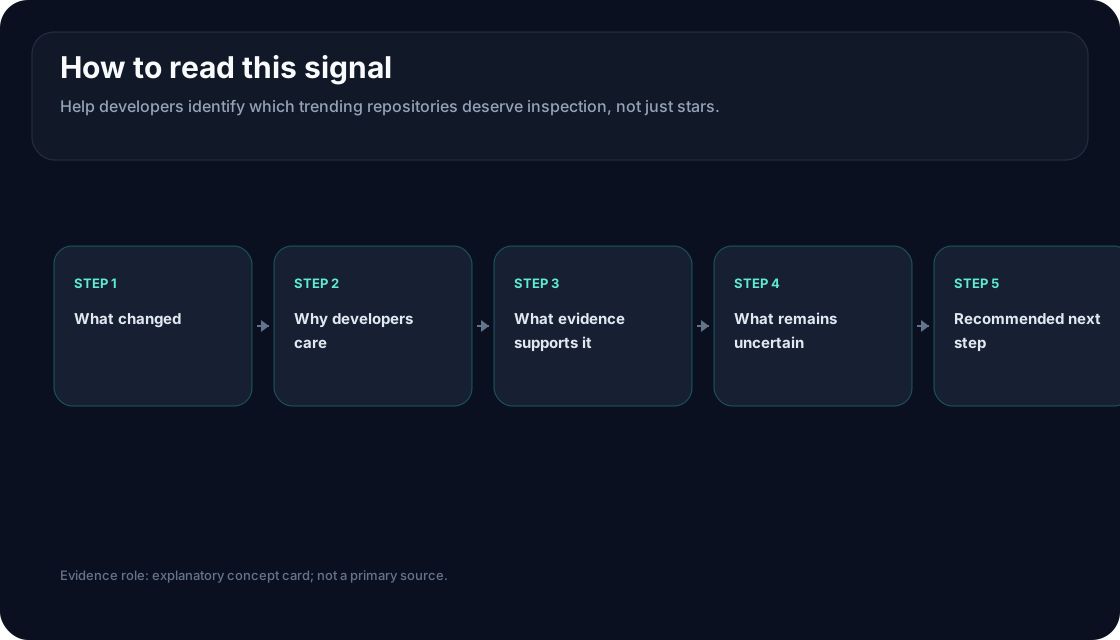
Concept map for the ranking
Section 05
Trend cluster one: plugin marketplaces and skill packs are becoming the agent control plane
The top repository, anthropics/claude-plugins-official, matters less because of its rank and more because of what it standardizes. The README describes a curated directory, a plugin layout with metadata, optional MCP configuration, commands, agents, skills, and documentation. It also includes a prominent warning: users should trust a plugin before installing, updating, or using it, because plugins may include MCP servers, files, or other software outside Anthropic's control.
That warning is the editorial lesson. Agent plugins are powerful precisely because they can package commands, skills, and integration surfaces. The more convenient the marketplace becomes, the more important provenance, update discipline, and least-privilege review become. Teams should treat plugin installation like dependency installation: check ownership, license, update history, configuration files, and any external server permissions before adding it to a daily coding workflow.
The same control-plane pattern appears in dotnet/skills and obra/superpowers. The .NET repository is domain-specific: it lists plugin areas for core .NET work, data access, diagnostics, MSBuild, NuGet, upgrades, MAUI, AI and ML, templates, tests, and ASP.NET. Superpowers is more methodology-oriented: it packages workflow discipline for planning, debugging, and software-development loops. Together, they show that agent quality is increasingly encoded in reusable instructions and workflows rather than one-off prompts.
Section 06
Trend cluster two: local code indexes compete with brute-force file exploration
colbymchenry/codegraph is the most technically concrete repository in the snapshot. The README positions it as a local semantic code-intelligence layer for Claude Code, Cursor, Codex CLI, and OpenCode. Its core promise is not that an agent becomes smarter in general; it is that the agent can query a pre-indexed graph of symbols, call relationships, and route patterns instead of repeatedly scanning files.
The repository's README contains benchmark claims, but this article does not treat those numbers as independently verified results. The safer takeaway is architectural: local indexing, SQLite-backed graph storage, tree-sitter extraction, FTS search, and framework-aware route mapping are a practical response to a known pain point in coding-agent sessions. Agents often spend context budget discovering the repository before they can reason about the actual task. A local index can shorten that discovery loop if it stays fresh and if the agent is steered to use the index instead of spawning file-reading exploration loops.
Before adopting this pattern, verify the operational details: supported languages, native dependency requirements, indexing overhead, file watcher behavior, and whether the generated context is reviewable enough for human engineers. A code index is useful only when it improves the quality of the next edit, not merely when it adds another MCP tool to the prompt surface.
Section 07
Trend cluster three: guidance files are still a low-cost way to improve agent behavior
multica-ai/andrej-karpathy-skills is intentionally simple: a guidance file designed to improve Claude Code behavior by addressing common failure modes. The README organizes the pattern around thinking before coding, simplicity first, surgical changes, and goal-driven execution. Those principles map directly to problems teams see in AI-assisted development: silent assumptions, overbuilt abstractions, unrelated rewrites, and unclear success criteria.
The lesson is not that one guidance file will solve agent reliability. It is that low-friction instruction artifacts remain valuable even as richer plugin ecosystems emerge. A team can inspect the pattern, adapt the principles to its own repository conventions, and combine them with tests, code review, and scoped tool permissions. Compared with installing a server or marketplace plugin, a guidance file is easier to audit and easier to roll back.
This also explains why Imbad0202/academic-research-skills and msitarzewski/agency-agents appeared lower in the full Trending list. Skill packs are no longer limited to coding; they are expanding into research, marketing, and organizational roles. For SignalForges readers, the relevant question is whether the skill improves developer decisions and verification, not whether it sounds like a comprehensive agent persona library.
Section 08
Inspect, watch, or treat as context
| Tier | Repositories | Reason | Next verification step |
|---|---|---|---|
| Inspect first | anthropics/claude-plugins-official; colbymchenry/codegraph; dotnet/skills | Strong fit for coding-agent workflows and enough primary evidence in this packet to guide inspection. | Read the README, plugin or install docs, license, recent commits, and any generated configuration before installation. |
| Inspect as methodology | obra/superpowers; multica-ai/andrej-karpathy-skills | They encode workflow discipline rather than runtime capability; value comes from adapting patterns, not blindly copying prompts. | Compare each principle against your team's review checklist, test policy, and rollback expectations. |
| Watch | ChromeDevTools/chrome-devtools-mcp; antoinezambelli/forge; can1357/oh-my-pi | The direction fits agent infrastructure, but this snapshot lacks enough enriched evidence for a recommendation. | Verify README scope, license, install path, issue surface, and security assumptions. |
| Context only | OpenWA; NotebookLM-py; academic and agency skill packs | Interesting ecosystem signals, but not all are core AI developer tooling for coding teams. | Only evaluate if they match a specific integration or learning need. |
Section 09
What not to infer from GitHub Trending
- A daily rank is not an adoption metric. It can reflect launch timing, social distribution, or a temporary attention burst.
- Star gain is not a benchmark. It says nothing by itself about code quality, security, maintainability, or team fit.
- A repository description is not an install guarantee. Verify the README, license, recent commits, issue surface, and configuration files before running a tool locally.
- README benchmark claims should be treated as project-supplied evidence unless independently reproduced. They can motivate inspection, but should not drive production decisions alone.
- Unofficial API wrappers and integration gateways may carry product-terms, privacy, or maintenance risks even when the code is open source.
Section 10
Methodology, source ledger, and refresh-sensitive notes
This article is based on the May 21 2026 GitHub Trending daily snapshot, GitHub repository metadata for the enriched repositories, README excerpts from the enriched repositories, and generated visual assets from the deterministic article asset pipeline. No hands-on installation, benchmark reproduction, or production testing was performed.
Primary sources used: GitHub Trending daily snapshot; anthropics/claude-plugins-official repository and README; colbymchenry/codegraph repository and README; multica-ai/andrej-karpathy-skills repository and README; dotnet/skills repository and README; obra/superpowers repository metadata; ChromeDevTools/chrome-devtools-mcp repository listing; plus the remaining repository pages listed in the ranking table for rank and description context.
Refresh-sensitive fields include Trending rank, daily star gain, total stars, open issues, pushed-at timestamps, license metadata, README headings, and repository descriptions. Re-check those values directly on GitHub before citing this article in an adoption review.
Section 11
Editorial conclusion
The May 21 snapshot is a useful inspection queue for developers working with coding agents. The clearest thesis is that agent tooling is moving toward reusable control surfaces: plugin marketplaces, skill standards, local code graphs, and domain-specific workflows. Inspect the first cluster if you are standardizing agent behavior across a team. Watch the MCP and terminal-harness projects if your next bottleneck is tool integration. Treat the rest as ecosystem context until primary sources justify a deeper review.
Use the May 21 ranking as an inspection queue for agent workflow infrastructure. Inspect Claude plugin structure, CodeGraph-style local indexing, and .NET skill packaging before broader watchlist items.
Best for
Developers and engineering teams tracking Claude Code, Cursor, Codex CLI, Copilot, OpenCode, MCP, and reusable agent-workflow infrastructure.
Avoid when
Avoid treating GitHub Trending rank or star gain as evidence of production readiness, security, or durable adoption.
Refresh-sensitive details
- GitHub Trending is a 24-hour attention snapshot; daily rankings shift frequently and do not indicate sustained interest or production readiness.
- Star counts, rank positions, license metadata, issue counts, and pushedAt timestamps are refresh-sensitive and may differ after publication.
- CodeGraph benchmark figures in its README are project-supplied and were not independently reproduced by SignalForges; the public article describes the architecture qualitatively instead of endorsing the precise performance claims.
- Unofficial API wrappers and integration gateways may carry product-terms, privacy, or maintenance risks even when their repository appears on Trending.
- 5 eligible repositories and 0 repositories were blocked are internal enrichment/audit counts from the collection report, not public adoption metrics.
Source Ledger
These are the primary references used to keep the article grounded. Pricing, limits, benchmark results, and model names are rechecked against the source type shown below.
| Source | Type | How it is used |
|---|---|---|
| GitHub Trending daily snapshot 2026-05-21 | ecosystem reference | Daily snapshot collected on 2026-05-21. GitHub Trending returned 19 repositories for the daily period. |
| anthropics/claude-plugins-official GitHub repository | official product | Rank #1 repository evidence for the Claude Code plugin directory, plugin structure, installation wording, and trust warning. |
| colbymchenry/codegraph GitHub repository | official product | Rank #2 repository evidence for local code knowledge graph positioning, supported coding agents, install path, and README-supplied benchmark context. |
| multica-ai/andrej-karpathy-skills GitHub repository | official product | Rank #3 repository evidence for the CLAUDE.md guidance-file pattern and four named principles. |
| dotnet/skills GitHub repository | official product | Rank #4 repository evidence for .NET team agent skills, plugin list, installation paths, and MIT license metadata. |
| obra/superpowers GitHub repository | official product | Rank #5 repository evidence for an agentic skills framework and software-development methodology. |
| ChromeDevTools/chrome-devtools-mcp GitHub repository | official product | Rank #8 repository page used as watchlist evidence for browser debugging through MCP. |
| GitHub API repository metadata | ecosystem reference | Metadata source for enriched repository license, pushedAt, total stars, issues, topics, and descriptions. |
What This Article Actually Claims
GitHub Trending returned 19 repositories for the daily period on 2026-05-21.
reports/github-trending.json generated at 2026-05-21T13:06:22Z.
5 eligible repositories were enriched with GitHub metadata; 0 repositories were blocked or restricted by editorial risk rules.
reports/github-trending.json enrichment and editorialRisk fields.
anthropics/claude-plugins-official ranked #1 with +674 stars gained, Python language, no declared license in repository metadata, and pushedAt 2026-05-21T08:36:50Z.
GitHub Trending daily snapshot and GitHub API repository metadata.
colbymchenry/codegraph ranked #2 with +2,123 stars gained, TypeScript language, MIT license, and pushedAt 2026-05-20T23:43:25Z.
GitHub Trending daily snapshot and GitHub API repository metadata.
multica-ai/andrej-karpathy-skills ranked #3 with +2,679 stars gained, no language reported in the Trending row, no declared license in repository metadata, and pushedAt 2026-04-20T10:05:04Z.
GitHub Trending daily snapshot and GitHub API repository metadata.
dotnet/skills ranked #4 with +96 stars gained, C# language, MIT license, and pushedAt 2026-05-21T11:14:53Z.
GitHub Trending daily snapshot and GitHub API repository metadata.
obra/superpowers ranked #5 with +1,743 stars gained, Shell language, MIT license, and pushedAt 2026-05-14T23:32:25Z.
GitHub Trending daily snapshot and GitHub API repository metadata.
ChromeDevTools/chrome-devtools-mcp ranked #8 with +132 stars gained and TypeScript language.
GitHub Trending daily snapshot.
anthropics/claude-plugins-official README describes a curated Claude Code plugin directory with plugins, external_plugins, plugin metadata, optional MCP configuration, commands, agents, skills, and README documentation.
Repository README excerpt collected in reports/github-trending.json.
colbymchenry/codegraph README positions CodeGraph as a local code knowledge graph for Claude Code, Cursor, Codex CLI, and OpenCode, using local SQLite storage and tree-sitter extraction.
Repository README via GitHub and zread-repo MCP.
dotnet/skills README lists .NET team core skills and custom agents across plugin areas including dotnet, dotnet-data, dotnet-diag, dotnet-msbuild, dotnet-nuget, dotnet-upgrade, dotnet-maui, dotnet-ai, dotnet-template-engine, dotnet-test, and dotnet-aspnet.
dotnet/skills README via zread-repo MCP.
Methodology
- Evidence comes from the May 21 2026 GitHub Trending snapshot, GitHub API metadata, README excerpts collected by the Growth OS collector, and additional repository README reads through the MCP zread-repo evidence layer.
- No hands-on installation, command execution, benchmark reproduction, or production evaluation was performed. The article does not claim first-person testing.
- Star gains, rank, total stars, open issues, pushedAt timestamps, license values, and README claims are refresh-sensitive and should be rechecked before adoption decisions.
- The article intentionally treats README benchmark claims as project-supplied evidence and does not present them as independently verified performance results.
Frequently asked
Questions readers ask
What should developers inspect first from this ranking?
Start with anthropics/claude-plugins-official for plugin-marketplace structure and trust boundaries, colbymchenry/codegraph for local code knowledge graphs, and dotnet/skills for domain-specific agent skills. Each has direct repository evidence in the article packet.
Does GitHub Trending prove these repositories are production-ready?
No. GitHub Trending is a short-window attention signal. It does not prove code quality, security, durability, or production adoption.
Was this article based on hands-on testing?
No. The article was drafted with AI assistance from repository metadata, README evidence, and the May 21 Trending snapshot, then reviewed against the SignalForges editorial method. It does not claim live installation or benchmark reproduction.